The British Library Add MS 11608: A Source of 17th-Century English Songs and Ornamentation
British Library Add MS 11608 is one of the most substantial surviving sources of mid-seventeenth-century English vocal music and an especially important witness to the practice of vocal ornamentation. Dated by the British Library to 1656–1659 and closely associated with John Hilton, the manuscript contains songs, dialogues, motets, catches, anthems, and other vocal pieces in English, Italian, and Latin. Several pieces survive with unusually elaborate divisions or alternative ornamented passages, making the manuscript especially useful for reconstructing how singers might embellish relatively simple melodic outlines in performance.

Johannes Vermeer, The Music Lesson, c. 1662–1665, oil on canvas (Royal Collection).
Nicholas Lanier’s ⏵︎ “Qual musico gentil”, preserved on f. 27v of Add MS 11608, sets stanza 43 of Canto XVI of Torquato Tasso’s Gerusalemme liberata. The text itself is strikingly musical: Tasso compares Armida, before she begins to speak, to a skilled musician who prepares the listener with soft introductory gestures. Lanier responds with a relatively simple melodic and harmonic framework that is extensively elaborated through written-out vocal divisions.
The ornamentation ranges widely across the voice and frequently expands individual syllables into long, flowing passages. Add MS 11608 also places the sign t above the penultimate note at the two principal cadences of the song, probably indicating a trillo. The written-out divisions make “Qual musico gentil” a particularly useful example of the Italianate vocal practices preserved in the manuscript.
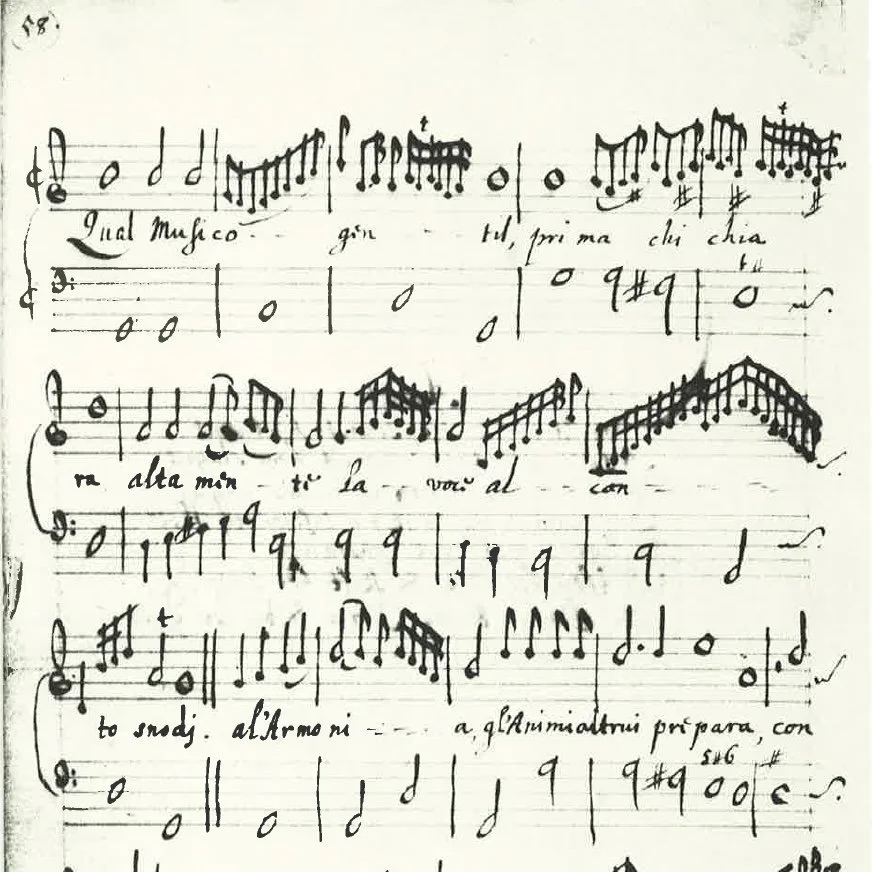
Nicholas Lanier, “Qual musico gentil,” British Library, Add MS 11608, f. 27v. Text from Canto XVI of Torquato Tasso’s Gerusalemme liberata.
The florid style of ornamentation in Add MS 11608 is not confined to its Italian repertory. Several English songs preserve extensive written-out divisions, including Robert Johnson’s ⏵︎ “Care-charming sleep” and ⏵︎ “Woods, rocks and mountains”, Thomas Brewer’s ⏵︎ “O that mine eyes could melt into a flood”, and John Wilson’s ⏵︎ “Take, o take those lips away”. These settings show that elaborate divisions had become an established feature of English solo song by the middle of the seventeenth century.
Among them, “Care-charming sleep” is particularly florid. The divisions form long ornamental figures around a comparatively simple melodic outline, sometimes replacing the value of a crotchet with groups of seven or nine semiquavers. The rhythmic notation of such passages cannot always be interpreted with absolute literalness, but the underlying pulse generally remains perceptible. Rather than functioning primarily as word painting, the divisions intensify and expand the expressive character of the melodic line.
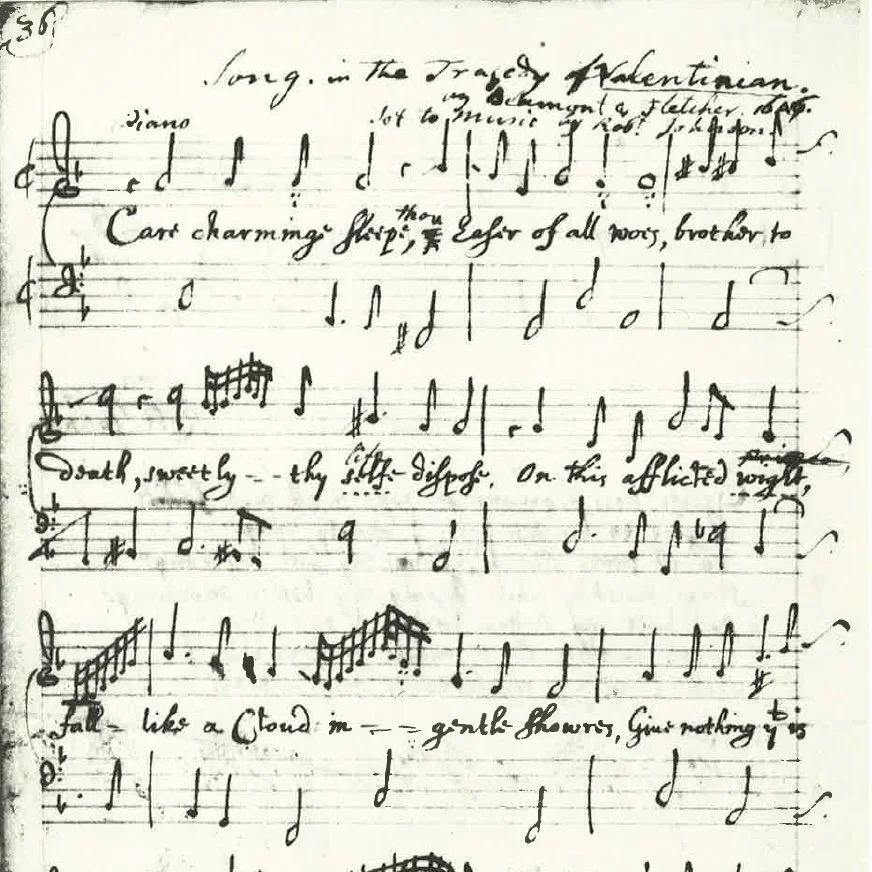
Robert Johnson, “Care-charming sleep,” from The Tragedy of Valentinian, British Library, Add MS 11608, ff. 16v–17r.
Thomas Brewer’s ⏵︎ “O that mine eyes could melt into a flood” offers a particularly striking example of expressive division writing in Add MS 11608. The song is sacred in subject, and its written-out ornaments substantially heighten the intensity of the vocal line. The divisions do not function primarily as literal word painting; instead, they amplify the emotional character of the text through increasingly elaborate melodic expansion. A closely related ornamented version also survives in Elizabeth Rogers’s manuscript, showing that this style of embellishment circulated beyond Add MS 11608.
John Wilson’s ⏵︎ “Take, o take those lips away” shows a more economical approach. The first verse contains only a small number of divisions, while the second offers several alternative ornaments. The most elaborate passage is reserved for the final cadence, giving the ornamentation a clear sense of proportion and direction. Rather than decorating every phrase equally, the manuscript concentrates its most florid writing at structurally important moments.
Add MS 11608 also preserves evidence of ornamentation as a flexible performance practice rather than a fixed written text. In several songs, alternative divisions were entered at the end of the piece, sometimes in a different hand. These additions suggest that singers or copyists used the manuscript to record more than one possible realization of the same passage.
A particularly clear example occurs in Nicholas Lanier’s ⏵︎ “No more shall meads” (Love’s Constancy). On f. 77r, the manuscript preserves four alternative versions of the final cadence, introduced by the note “as Mr. Elliston sings it.” The annotation is especially valuable because it connects written-out ornamentation with the practice of a named singer, showing that different cadential divisions could circulate as recognizable features of individual performance.
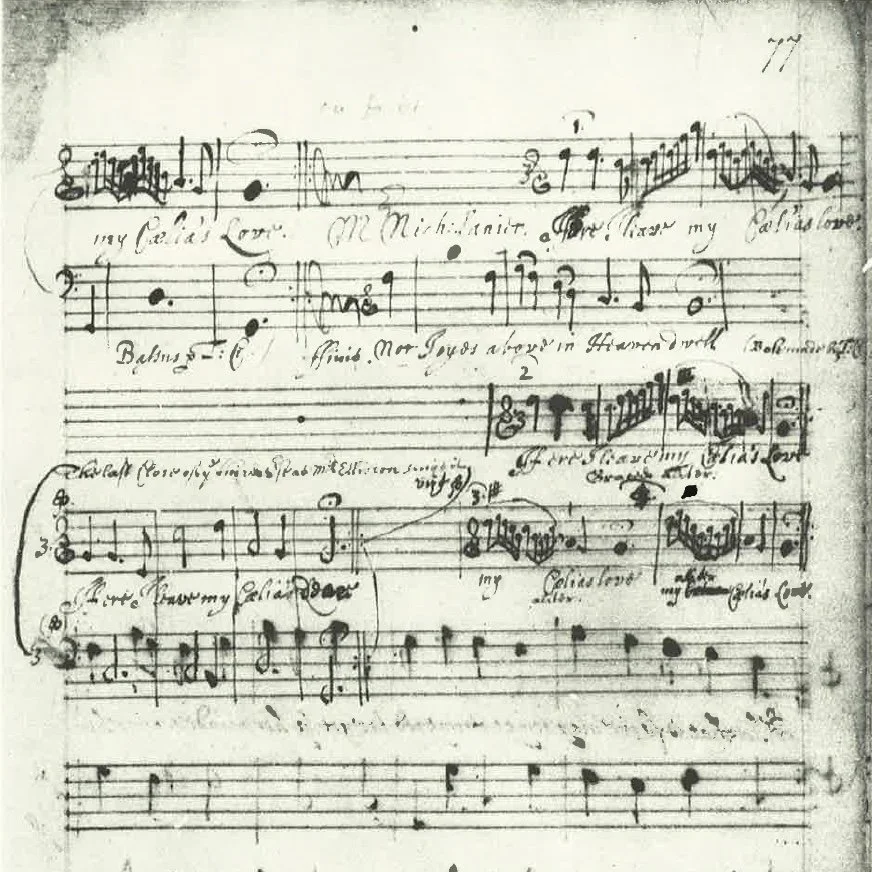
Alternative cadential divisions for Nicholas Lanier’s “No more shall meads,” annotated “as Mr. Elliston sings it,” British Library, Add MS 11608, f. 77r.
Taken together, the ornamented songs in Add MS 11608 show that vocal divisions in mid-seventeenth-century England were neither uniform nor fixed. Some pieces preserve highly elaborate written-out ornamentation, while others offer only a few alternative divisions at cadences or other structural points. The manuscript also records variants associated with individual singers, providing unusually direct evidence of the relationship between written notation and performance practice.
Add MS 11608 is therefore valuable not only as a repertory source but also as a document of how seventeenth-century singers adapted, varied, and transmitted ornamented versions of songs in practice.
References
Chan, Mary. (1979). “John Hilton’s Manuscript British Library Add. MS 11608.” Music & Letters, 60(4), 440–449.
Huws Jones, Edward. (1989). The Performance of English Song, 1610–1670. Outstanding Dissertations in Music from British Universities. New York and London: Garland.
Jorgens, Elise Bickford (ed.). (1986). English Song, 1600–1675: British Library Manuscripts, Part IV: Add. MS 11608; Add. MS 32339. Vol. 4. New York and London: Garland.