Depictions of the Virgin Mary in Italian Solo Song of the 17th Century
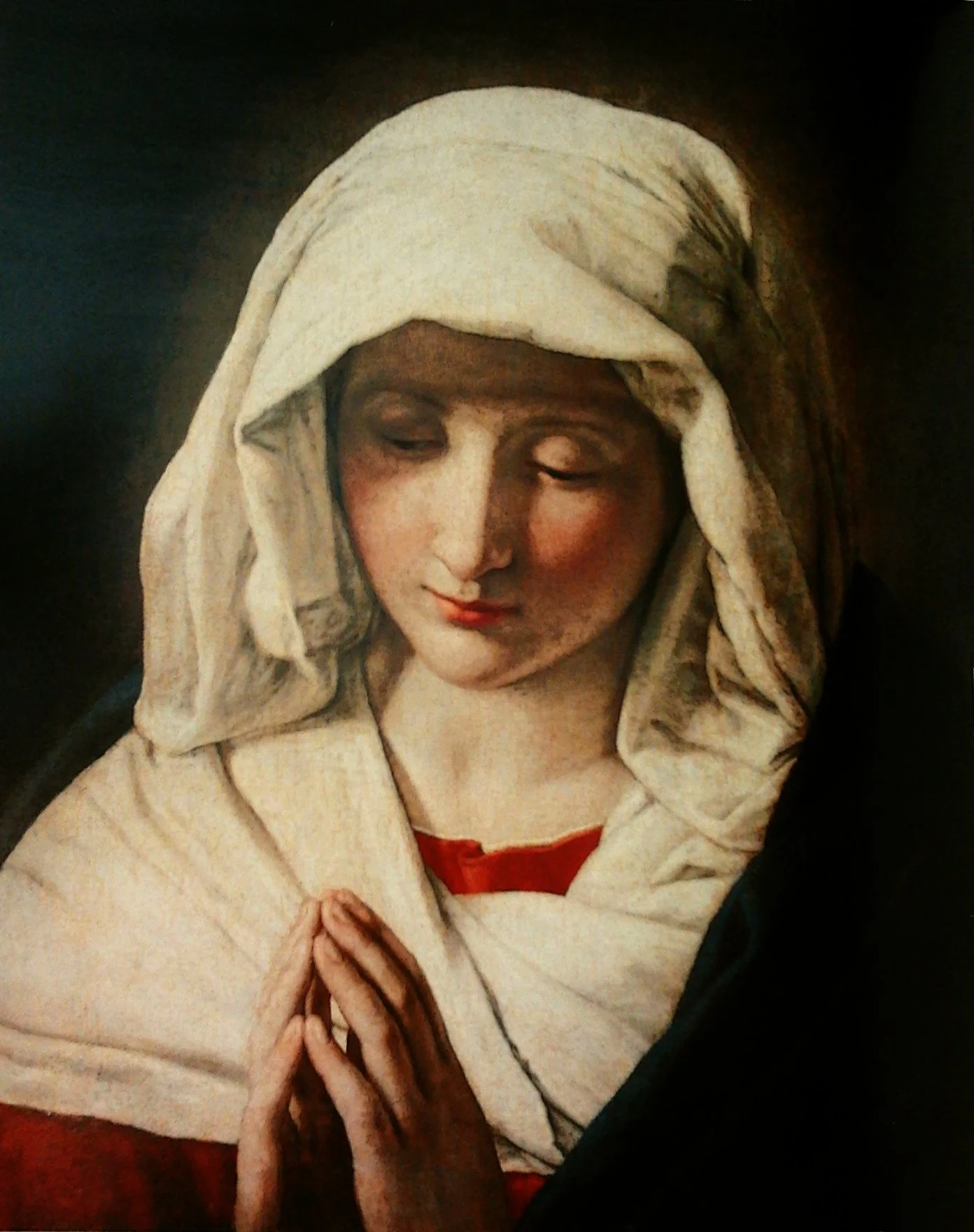
Sassoferrato (Giovanni Battista Salvi), The Virgin in Prayer, 1640–50, oil on canvas (National Gallery, London).
The Virgin Mary became an important subject in seventeenth-century Italian solo song, where composers gave musical voice to different aspects of her devotional identity. Some works praise Mary as intercessor and comforter; others present her as the mother of Christ, either singing to the infant Jesus or mourning him at the Crucifixion. These contrasting roles—mother, mourner, and object of devotion—provided composers with a wide range of textual and musical possibilities, from lullabies and devotional monodies to extended laments.
Giovanni Felice Sances’s ⏵︎ Pianto della Madonna, published in his Motetti a voce sola (Venice, 1638), sets the Stabat Mater for solo voice and continuo. The work alternates recitative-like passages with sections in triple meter built over a chromatic descending tetrachord. This recurring bass gives the lament a strong structural identity while allowing the vocal line to move between declamation and more lyrical writing. Sances’s use of the descending tetrachord places the work within the broader seventeenth-century association between descending bass patterns and lament.
Claudio Monteverdi’s ⏵︎ Pianto della Madonna (Iam moriar, mi fili) takes a different route. It is a Latin sacred contrafactum of the surviving lament from L’Arianna (1608), in which Ariadne’s abandonment is transformed into the Virgin Mary’s mourning for Christ. Monteverdi included the piece at the end of his Selva morale e spirituale (1641), thereby giving the adaptation an authorized place within his sacred output. The musical substance of the secular lament is largely retained, but the change of text and dramatic context redirects its expressive language toward Marian devotion.
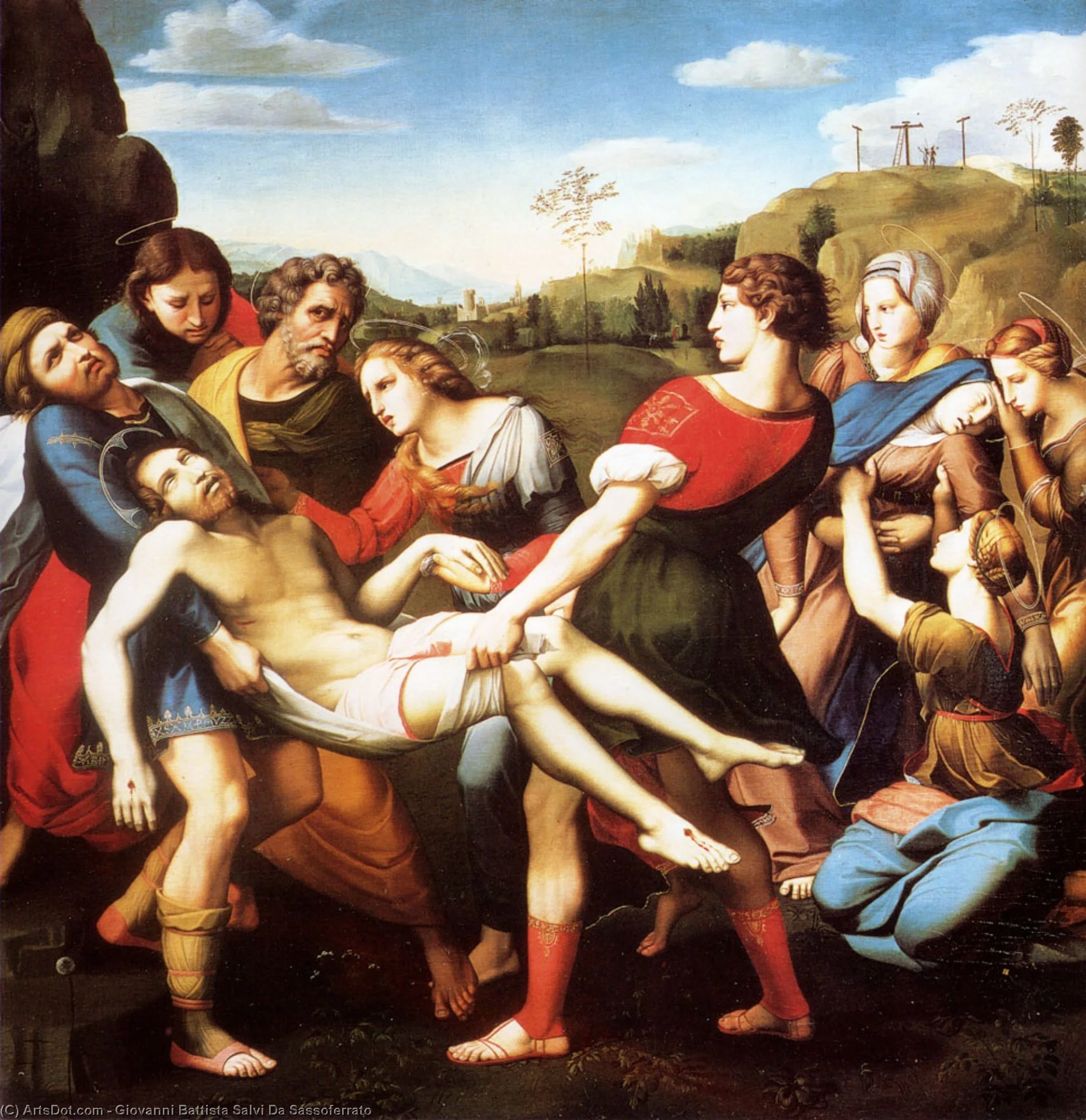
Sassoferrato, The Entombment, after Raphael, seventeenth century (San Pietro, Perugia).
Francesca Caccini’s ⏵︎ Maria, dolce Maria, published in her Il primo libro delle musiche (Florence, 1618), praises the Virgin Mary in her role as comforter and source of spiritual consolation. The text, by Michelangelo Buonarroti the Younger, repeatedly invokes Mary’s name as one that tempers sorrow, calms affliction, and brings serenity to the soul.
Caccini’s setting is restrained in its harmonic movement, with the basso continuo proceeding largely through slow-changing sonorities and rhythmic variation used sparingly. Chromaticism and several dissonances subtly intensify the text. The harmonic climax comes on the phrase “ogni affano acqueta,” where a strong discord expresses anguish before resolving into a more soothing cadence.
Tarquinio Merula’s ⏵︎ Hor ch'è tempo di dormire, subtitled Canzonetta spirituale sopra alla nanna, was published in his Curtio precipitato et altri capricci (Venice, 1638). The piece presents the Virgin Mary singing the Christ Child to sleep, but the tenderness of the lullaby is repeatedly interrupted by images of his future Passion. Mary asks the infant to close his eyes, drink from her breast, and rest his limbs, while anticipating the darkness at the Crucifixion, the vinegar and gall, the nails, chains, and the Cross.
Merula builds the song over a persistent two-note bass figure, A–B-flat, whose repetitive rocking motion evokes the regularity of a cradle song. Against this ostinato, the vocal line unfolds in a series of strophic variations. The musical simplicity of the bass contrasts with the increasingly disturbing imagery of the text, so that maternal tenderness and foreknowledge of suffering remain present at the same time.

Sassoferrato, Madonna with the Christ Child, first half of the seventeenth century, oil on canvas (private collection).
Orazio Michi’s ⏵︎ Sola fra’ suoi più cari, a lament for solo voice and basso continuo, sets a canzone by Giambattista Marino and survives in four manuscript sources. The poem places the Virgin Mary at the foot of the Cross as she watches the dying Christ. Its opening stanzas describe her from an external perspective: overwhelmed by grief, she stands motionless before her wounded son until her tears finally give way to speech. Mary then addresses Christ directly, asking who has inflicted such suffering on him and pleading with him to delay his death so that she might die with him.
The movement from narration to direct speech gives the poem a distinctly dramatic shape. Michi’s setting is predominantly declamatory, allowing the changing pace of Marino’s verse and Mary’s increasingly urgent appeals to determine the vocal line. The work survives in manuscripts in Rome, Bologna, and Hamburg, with differences between the sources in such details as vocal ornamentation and rhythmic notation.
Antonia Bembo’s ⏵︎ Lamento della Vergine presents the Crucifixion from the perspective of the Virgin Mary. The cantata opens in F minor, a tonal area that contributes to the atmosphere of distress. Its key signature recalls the alternative signature of Bembo’s “Habbi pietà di me” and appears nowhere else in Produzioni armoniche.
As Claire Fontijn observes, the work is divided into twelve sections, with the actual lament occupying the sixth and therefore forming its literal centerpiece. Fontijn suggests that Bembo modeled the cantata on Barbara Strozzi’s Il Lamento, Op. 2 (1651), which dramatizes the execution of Henri de Cinq-Mars in 1642. Bembo transfers the expressive procedures of the secular lament to a Marian subject, placing the Virgin’s grief within a form already associated with theatrical representations of loss and death.
These works reveal the range of Marian subjects cultivated in seventeenth-century Italian solo song. The Virgin appears as intercessor, mother, mourner, and dramatic protagonist, while composers draw on monody, ostinato basses, lullaby forms, lament structures, and sacred contrafacta to shape these different devotional roles. The contrast between consolation, maternal tenderness, and grief at the Crucifixion gives the repertory much of its expressive variety.
A selection of these works can be heard in my YouTube playlist ⏵︎ Depictions of Virgin Mary in 17th Century Italian Song, with transcriptions available through Early Music Scores.
References
Fontijn, Claire. (2000). “The Virgin’s Voice: Representations of Mary in Seventeenth-Century Italian Song.” In Naomi J. Miller and Naomi Yavneh (eds.), Maternal Measures: Figuring Caregiving in the Early Modern Period, 135–162. Ashgate.
Fontijn, Claire. (2006).Desperate Measures: The Life and Music of Antonia Padoani Bembo. Oxford University Press.
Kaleva, Daniela. (2020). “Contextual History through Rhetorical Visuality in Performing Monteverdi’s Il pianto della Madonna.” In Nancy November (ed.), Performing History: Approaches to History Across Musicology, 72–98. Academic Studies Press.
Merula, Tarquinio. (2012).Curtio precipitato et altri capricii (1638). Edited by Phoebe Jevtovic. Recent Researches in the Music of the Baroque Era, 177. A-R Editions.
Raney, Carolyn. (1971).Francesca Caccini, Musician to the Medici, and Her Primo Libro (1618). Ph.D. dissertation, New York University.
Rosand, Ellen. (1979). “The Descending Tetrachord: An Emblem of Lament.” The Musical Quarterly, 65(3), 346–359.
Ziane, Alexandra. (2020). “Orazio Michi: Contemporary Testimonials, Documents, and Work.” In Martina Papiro (ed.), Groß Geigen um 1500 • Orazio Michi und die Harfe um 1600, 243–272. Basel: Schwabe Verlag.
Ziane, Alexandra. (2020). “List of Works by Orazio Michi (c. 1595–1641).” In Martina Papiro (ed.), Groß Geigen um 1500 • Orazio Michi und die Harfe um 1600, 273–279. Basel: Schwabe Verlag.