Egerton MS 2971: A Source of Ornamented Early Seventeenth-Century Italian and English Songs
The manuscript and its repertory
British Library, Egerton MS 2971 is an important source for the study of vocal ornamentation in early seventeenth-century England. Dating from the first quarter of the century, the 37-folio manuscript contains English and Italian songs with accompaniments in score for harpsichord or, apparently, bass viol, as well as music for lyra viol. Thirteen vocal settings are notably florid: some are unique, while others can be compared with simpler concordant sources. The manuscript is therefore especially valuable for examining how written divisions were applied to both Italian and English repertory.
The manuscript belonged at an early date to Robert Downes, whose name appears among its marks of ownership. Its practical character is reinforced by a table of ornament signs pasted onto the final flyleaf and headed “Characters for ye graces of ye viol.” The table identifies graces executed with the left hand and others produced with the bow. Several Italian songs pair extensively ornamented vocal lines with accompaniments in lyra-viol tablature, connecting this instrumental evidence directly with the manuscript’s vocal repertory.
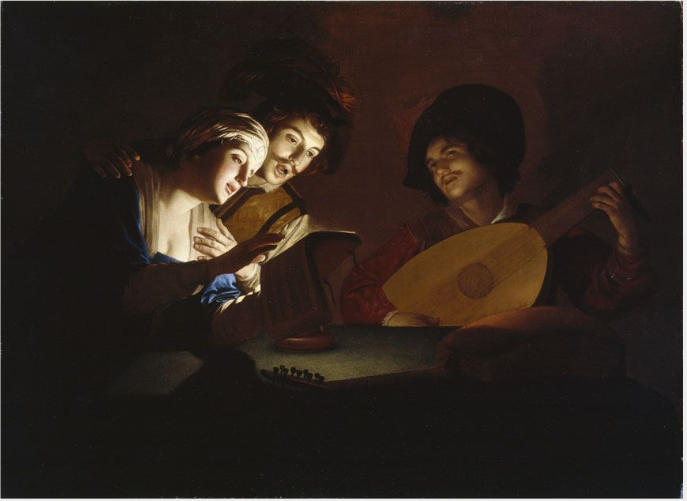
Gerrit van Honthorst, A Musical Party, c. 1616–1618, oil on canvas (National Gallery of Ireland, Dublin).
Italian monody and lyra-viol accompaniment
Among the Italian repertory in Egerton MS 2971 are extensively ornamented versions of Giulio Caccini’s ⏵︎ “Dolcissimo sospiro” and ⏵︎ “Amarilli mia bella”, both originally published in Le nuove musiche (Florence, 1602). In the manuscript, long written-out divisions transform the vocal lines, which are accompanied by lyra-viol tablature. The underlying melodies remain recognizable, but the degree of elaboration is far greater than in Caccini’s printed versions.
These settings are especially striking when read alongside Caccini’s own reservations about elaborate divisions that interfere with the expression of the text. The Egerton versions nevertheless subject his songs to precisely the kind of extensive embellishment that circulated in early seventeenth-century performance. Rather than merely adding isolated ornaments, the divisions often reshape complete phrases and respond to larger musical and poetic structures.
Egerton MS 2971 also contains anonymous settings of two successive portions of Mirtillo’s speech from Act I, scene 2 of Giovanni Battista Guarini’s Il pastor fido: ⏵︎ “Cruda Amarilli” and “Ma grideran per me le piagge e i monti.” Mirtillo laments Amarilli’s cruelty and resolves to die in silence. The poem was famously set by Monteverdi, Marenzio, Wert, d’India, and others, but the setting preserved in Egerton MS 2971 does not correspond to those better-known versions.
Like the Caccini songs, “Cruda Amarilli” is transmitted for solo voice with lyra-viol tablature and an elaborately diminished vocal line. “Cruda Amarilli” appears on ff. 27v–28r, while its continuation, “Ma grideran per me le piagge e i monti,” is copied earlier on ff. 25v–26r. An unornamented version of the same song, with unfigured bass, survives in Tenbury MS 1018.
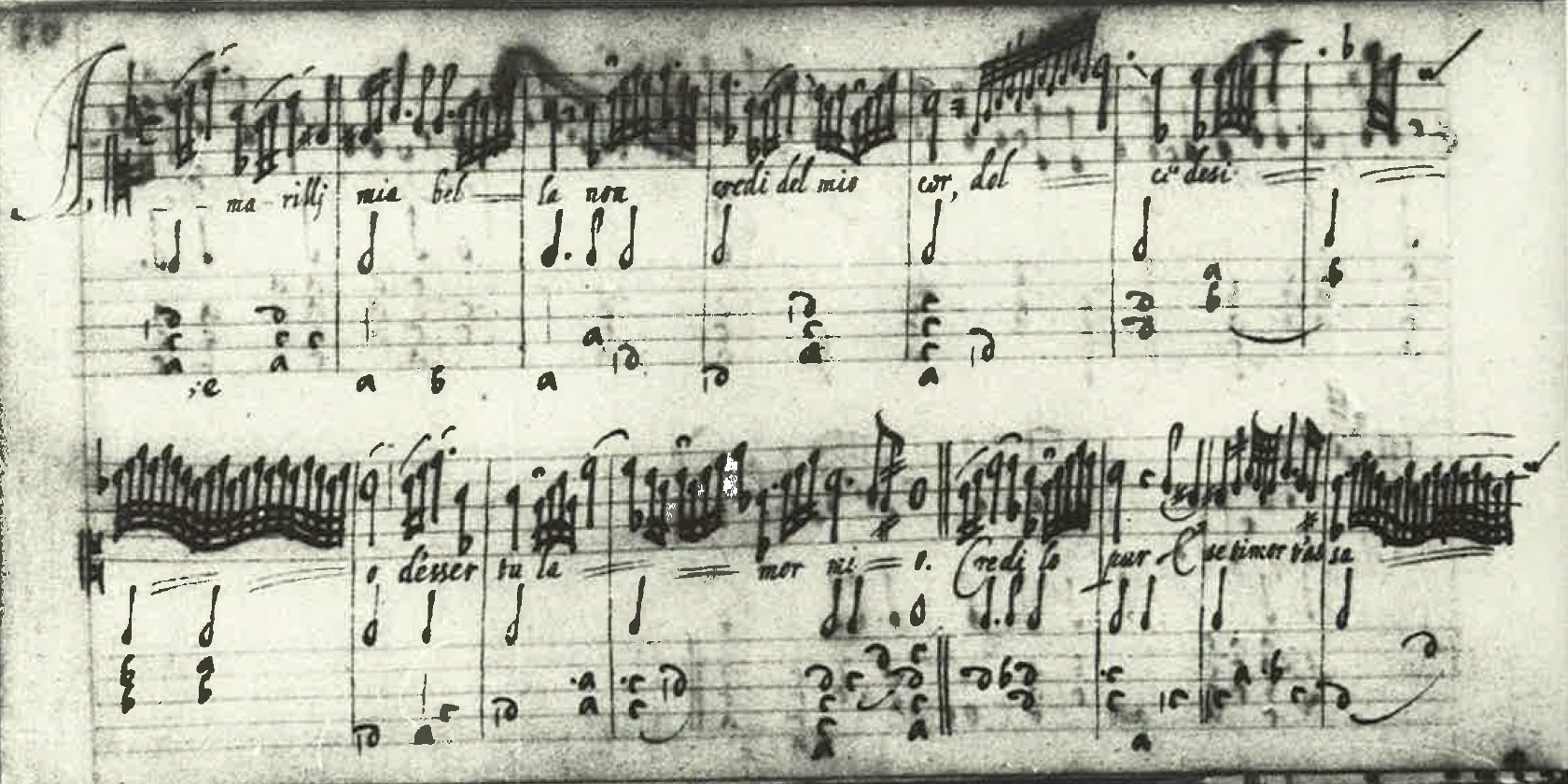
Giulio Caccini, “Amarilli mia bella,” ornamented version, British Library, Egerton MS 2971, f. 28v.
English divisions and adaptations
The English songs in Egerton MS 2971 generally employ a more restrained style of division than the Italian settings. Written-out shakes and double relishes occur frequently, particularly in songs such as “Drown not with tears” and John Wilbye’s ⏵︎ “Weep mine eyes”. These ornaments often concentrate around cadences and sustained notes, producing a more contained style of embellishment than the long, rhythmically flexible divisions found in the Italian repertory.
“Weep mine eyes” is especially instructive because Wilbye’s original five-part madrigal can be compared with the ornamented two-part adaptation preserved in Egerton MS 2971. The manuscript recasts the polyphonic work for a more intimate performing context and introduces written-out divisions, showing how an English madrigal could be reshaped in transmission.
⏵︎ “This merry pleasant spring” provides another clear comparison. The song also survives in the Turpyn Book, but the version in Egerton MS 2971 is considerably more ornamented. Similarly, an unornamented version of ⏵︎ “Sweet was the song the Virgin sung” survives in William Ballet’s lute book, while the Egerton version elaborates the melodic line with written-out divisions.
Not every English song in the manuscript is ornamented. The anonymous “Gently blow, you sweet western wind” is comparatively plain, but its bass is identical to that of Tobias Hume’s “Captaine Humes Galliard,” published in The First Part of Ayres (1605). Mary Cyr first drew attention to this relationship, and Edward Huws Jones observed that the song could therefore be performed over Hume’s more elaborate divisions. Because Hume’s print predates the surviving manuscript copy, the vocal setting was probably entered later, although the direction of borrowing cannot be established with certainty.
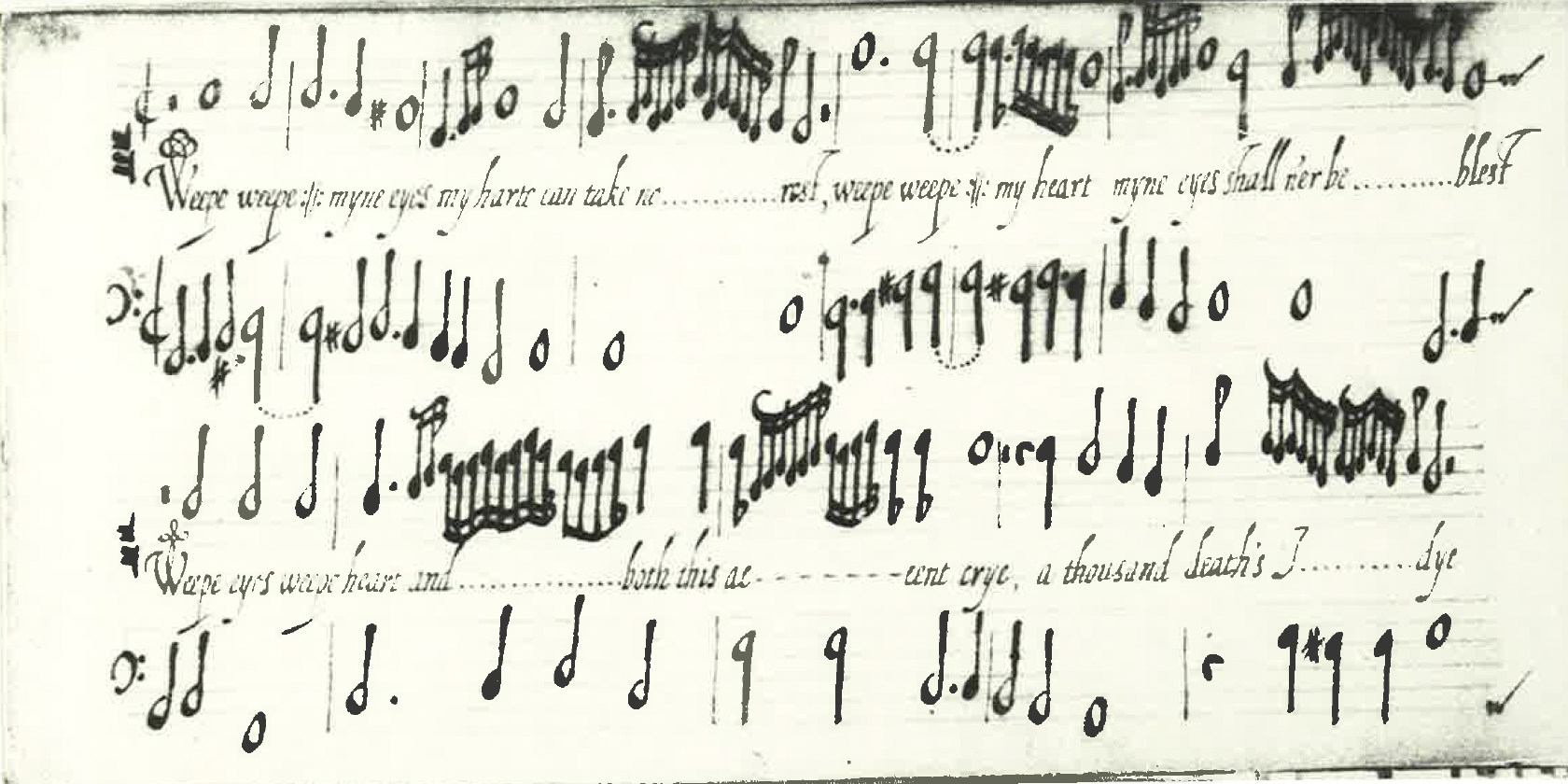
John Wilbye, “Weep mine eyes,” ornamented two-part version, British Library, Egerton MS 2971, f. 30v.
An Italian concordance
A further comparison is provided by the anonymous ⏵︎ “O bella più che le stelle Diana”. Egerton MS 2971 preserves the song with extensive divisions, while a simpler version was printed in Robert Dowland’s A Musicall Banquet (1610). The contrast offers another view of the relationship between a relatively plain printed melody and the florid vocal practice documented in the manuscript.
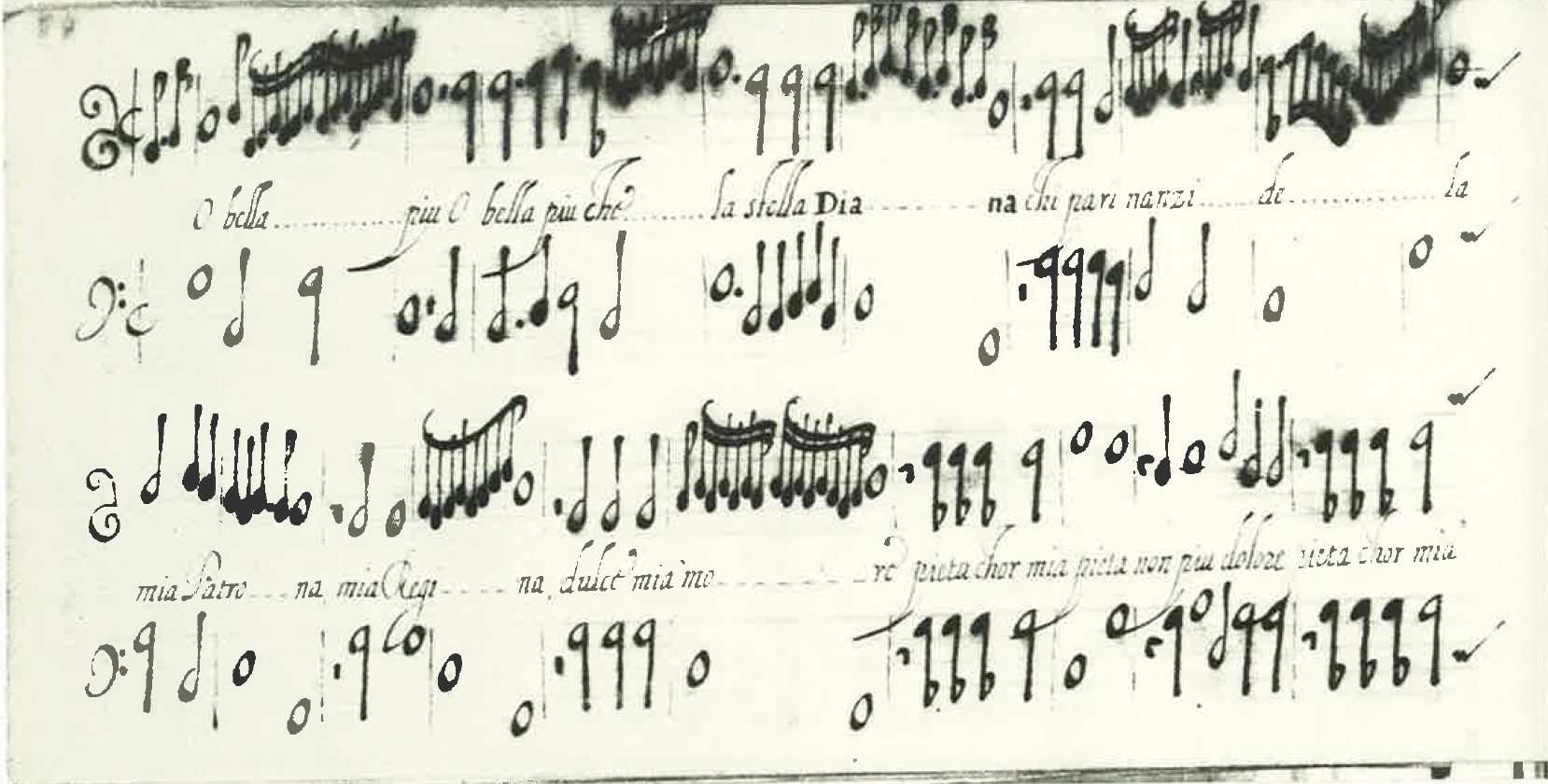
Anonymous, “O bella più che le stelle Diana,” with divisions, British Library, Egerton MS 2971, f. 22v.
Evidence of performance practice
Egerton MS 2971 preserves several approaches to the adaptation and embellishment of early seventeenth-century song. Its written-out divisions, lyra-viol accompaniments, concordances with less ornamented sources, and adaptations of pre-existing music make it valuable not simply as a collection of repertory but as evidence of how songs could be reshaped in performance and transmission in early seventeenth-century England.
References
Bass, John. (2008). “Would Caccini Approve? A Closer Look at Egerton 2971 and Florid Monody.” Early Music, 36(1), 81–94.
Cyr, Mary. (1971). “A Seventeenth-Century Source of Ornamentation for Voice and Viol: British Museum MS. Egerton 2971.” R.M.A. Research Chronicle, 9, 53–72.
Huws Jones, Edward. (1989). The Performance of English Song, 1610–1670. New York and London: Garland.
Jorgens, Elise Bickford (ed.). (1986). English Song, 1600–1675: British Library Manuscripts, Part I: Add. MS 15117; Egerton MS 2971; Add. MS 24665; Add. MS 29481, ff. 2–26v. Vol. 1. New York and London: Garland.