English Mad Songs
English mad songs developed from a longer tradition of representing madness in English ballads and theatre, but the genre flourished particularly on the Restoration stage in the later seventeenth century. Rather than following a fixed musical form, these songs typically portray characters in states of mental or emotional disturbance. Their texts may shift abruptly between grief, desire, jealousy, rage, memory, and fantasy, while the music responds through short contrasting sections, changes of metre and tempo, declamatory writing, melismas, repetition, and shifts in harmony.
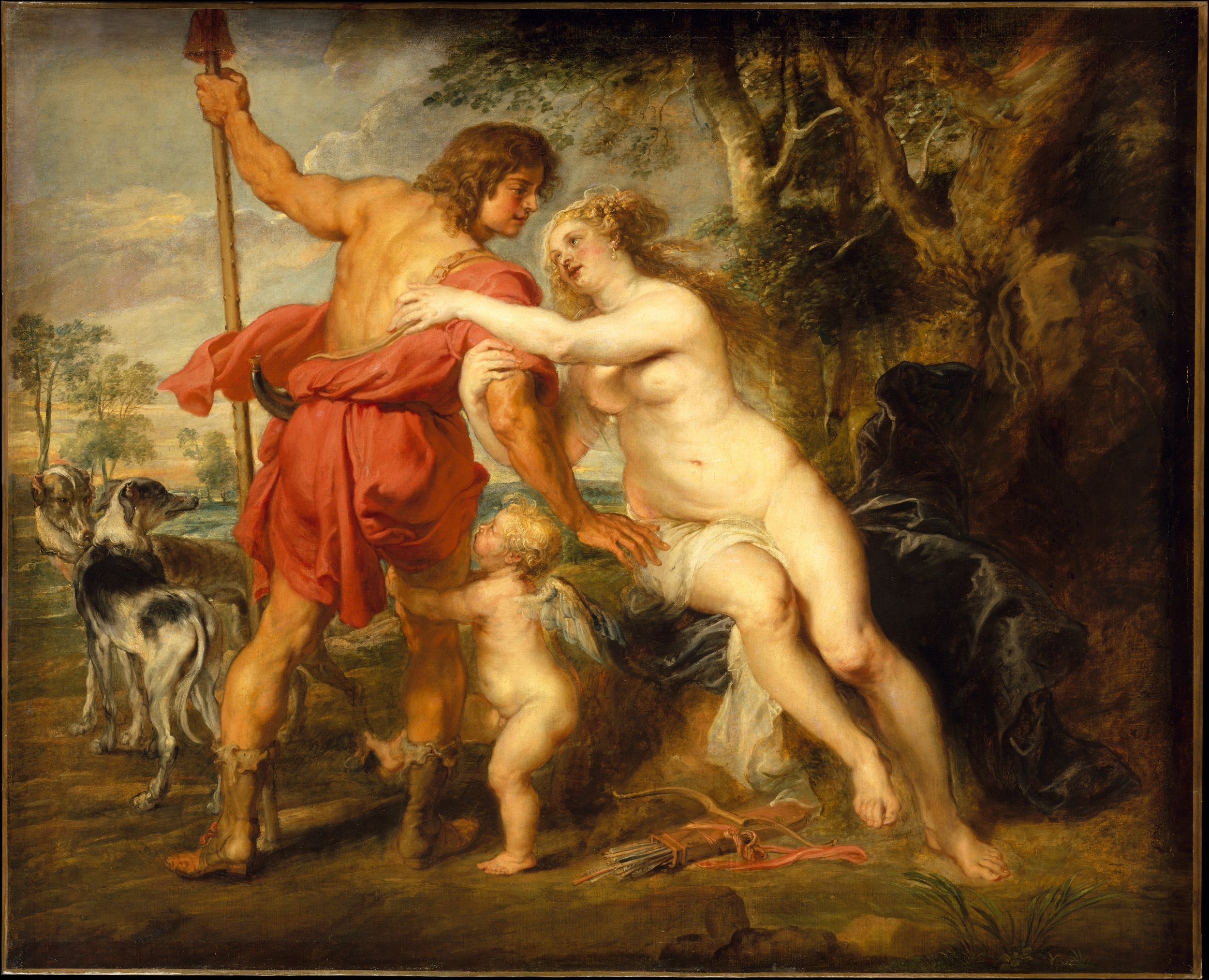
Peter Paul Rubens, Venus and Adonis, probably mid-1630s, oil on canvas (The Metropolitan Museum of Art, New York).
Composers who cultivated the mad song included Henry Purcell, John Eccles, Daniel Purcell, John Blow, and John Weldon. Among them, Eccles made particularly extensive use of the genre in music for the London stage during the 1690s.
Eccles’s ⏵︎ “I burn, my brain consumes to ashes” was written for Thomas D'Urfey's The Comical History of Don Quixote, Part II (1694), and sung by Anne Bracegirdle in the role of Marcella. Driven mad by unrequited love, Marcella describes her suffering through images of burning, lightning, and consuming fire. Eccles responds to the text with an intensely declamatory vocal line, rapid changes of gesture, and increasingly agitated writing, making the song a particularly vivid example of the Restoration mad-song tradition.
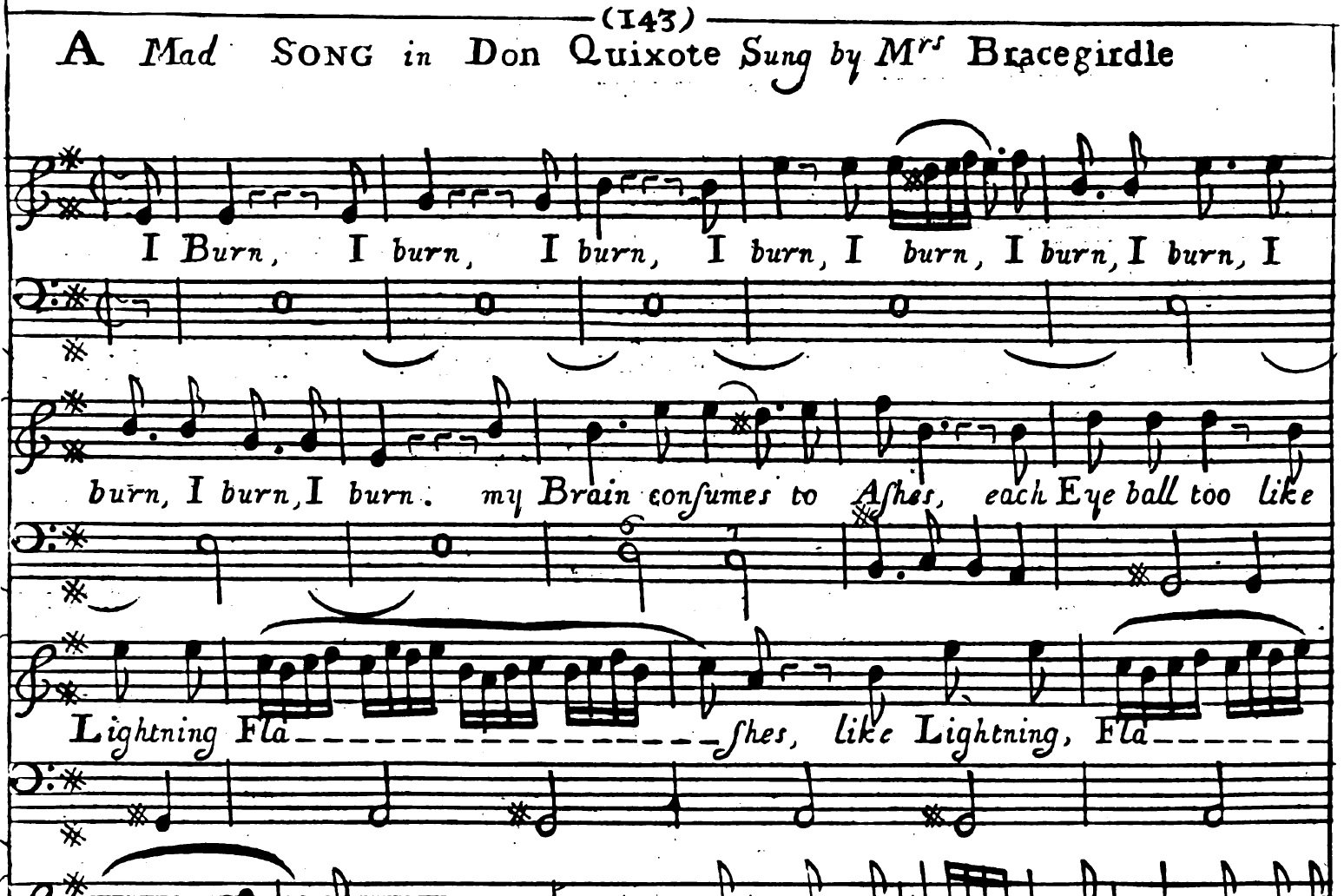
John Eccles, “I burn, my brain consumes to ashes,” from A Collection of Songs (London: John Walsh and John Hare, 1704).
Eccles’s setting of ⏵︎ “Restless in thought, disturb’d in mind”, written for She Ventures and He Wins (1695) and sung by Mrs. Hodgson, opens with two extended melismas over a sustained G in the bass. Although the vocal line moves restlessly, both melismas repeatedly return to their initial pitch, creating a tension between melodic activity and harmonic stasis. This musical circularity reflects the text: the speaker is “fated” to love, her heart is “enslav’d,” and she finds herself unable to withdraw when the beloved is present. The setting of “disturb’d” introduces greater harmonic movement toward B-flat, although much of the passage remains anchored by a dominant pedal.
The song proceeds through several contrasting sections. After the expansive opening, Eccles introduces shorter imitative exchanges between voice and continuo and emphasizes individual words through repetition, notably “no.” The final section, in cut time, initially takes on a more animated character, but its close changes the effect: the final setting of “in vain” brings the song to a more subdued conclusion, reinforcing the speaker’s recognition that her love is without hope.
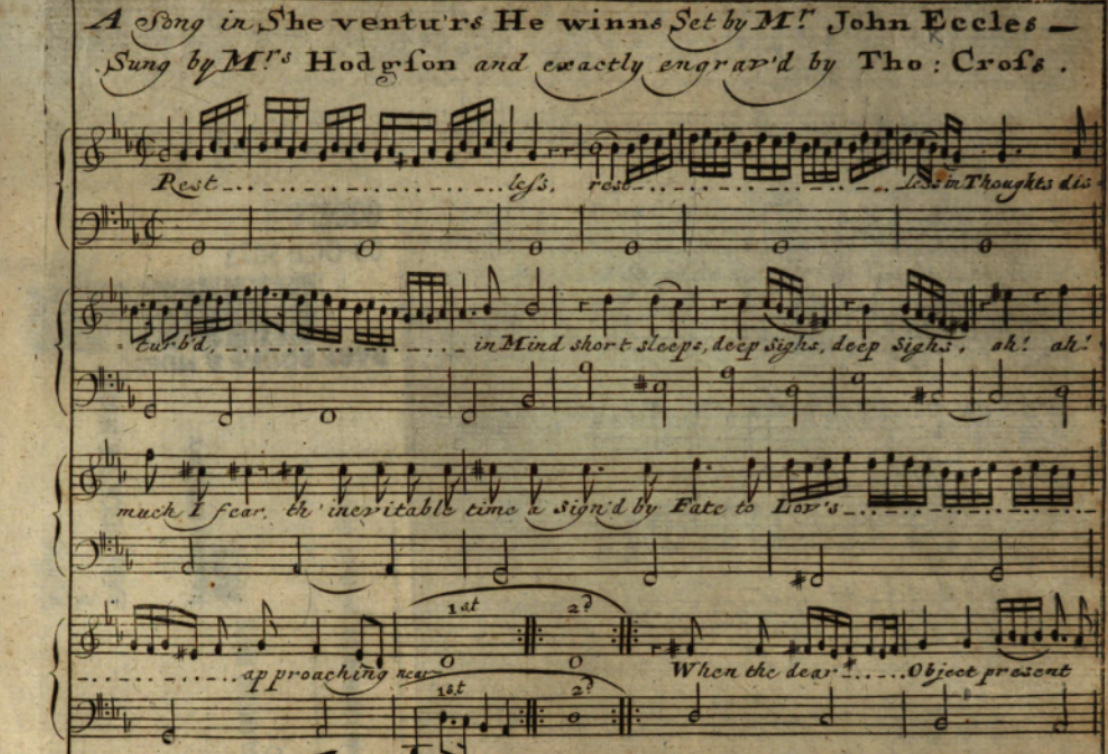
John Eccles, “Restless in thought,” from She Ventures and He Wins, sung by Mrs. Hodgson, as printed in A Collection of Songs (London: John Walsh, 1704).
Daniel Purcell’s ⏵︎ “Morpheus, thou gentle god of soft repose” was written for Abel Boyer’s adaptation of Racine’s Iphigénie, performed in 1699 and published the following year as Achilles: or, Iphigenia in Aulis. The song gives musical expression to the jealousy and despair of Eriphile. It was performed by Mrs. Erwin, a professional singer rather than an actress in the play; her performance represents Eriphile’s troubled state of mind.
Purcell shapes the song as a succession of contrasting sections. The opening invocation to Morpheus is expansive and melismatic, followed by a slower triple-metre passage in which the speaker longs for sleep and release from suffering. A more declamatory section then reveals jealousy as the source of her unrest, with increasingly chromatic writing intensifying the disturbance. The final section turns decisively from the desire for repose to rage and violence, culminating in the threat: “I must my rival or myself destroy.”
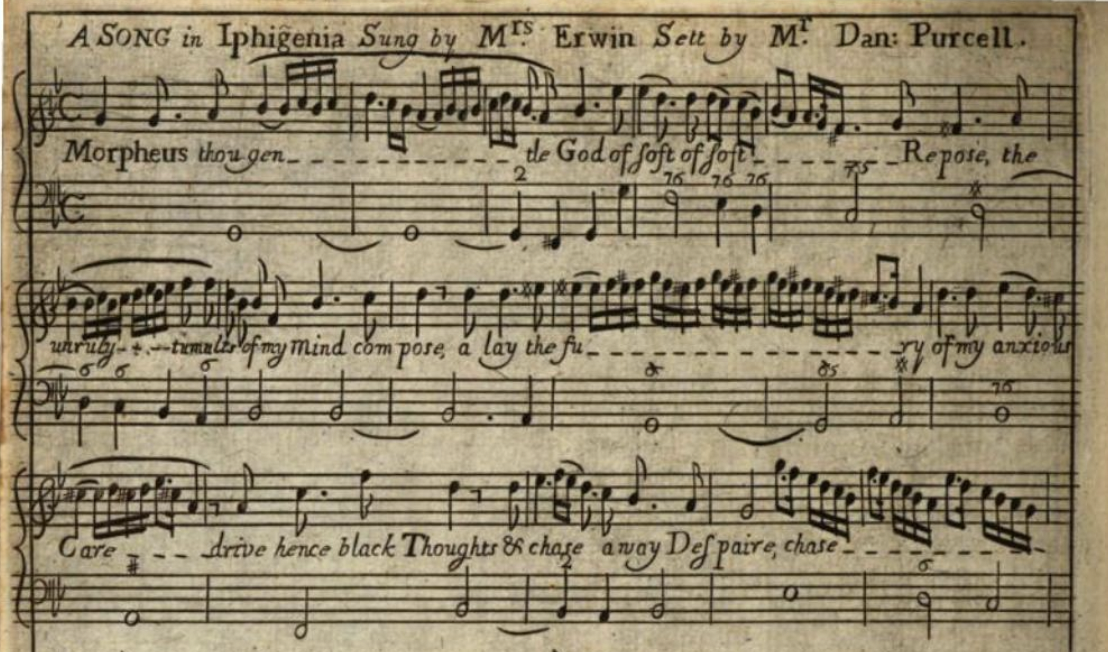
Daniel Purcell, “Morpheus, thou gentle god,” from A Collection of the Choicest Songs & Dialogues (London: John Walsh, 1705).
English mad songs occupy a distinctive place in late seventeenth-century theatrical music. Their sectional forms, abrupt contrasts, declamatory passages, melismas, repetition, and harmonic instability gave composers considerable flexibility in representing disturbed thought and changing emotional states. In works by Eccles and Daniel Purcell, these musical devices are closely connected with the dramatic situations and performers for whom the songs were written.
For a broader survey of the repertory, Anthony Rooley’s essay English Song: Mad Song provides a useful introduction. A selection of these works can also be heard in my YouTube playlist “English Mad Songs”, with transcriptions available through Early Music Scores.
References
Jones, Suzanne. (2024). “Amphibious Author: Abel Boyer, Iphigénie, and Huguenot Migration.” Early Modern French Studies, 46(2), 150–165.
Lowerre, Kathryn. (2017). Music and Musicians on the London Stage, 1695–1705. Routledge.
Rooley, Anthony. (2007). English Song: Mad Song. Schola Cantorum Basiliensis – Musik-Akademie der Stadt Basel.