Baroque Women Composers
Women were active as composers across the diverse musical environments of seventeenth-century Europe. Some, such as Francesca Caccini, Barbara Strozzi, and Antonia Bembo, were closely connected with professional courtly or secular musical circles; others composed within convents, where music could form an important part of religious and cultural life. Their surviving works encompass monody, madrigals, motets, cantatas, arias, and other genres central to seventeenth-century musical culture.
This selection explores some of these composers through representative works, placing their music within the genres and traditions in which they participated.
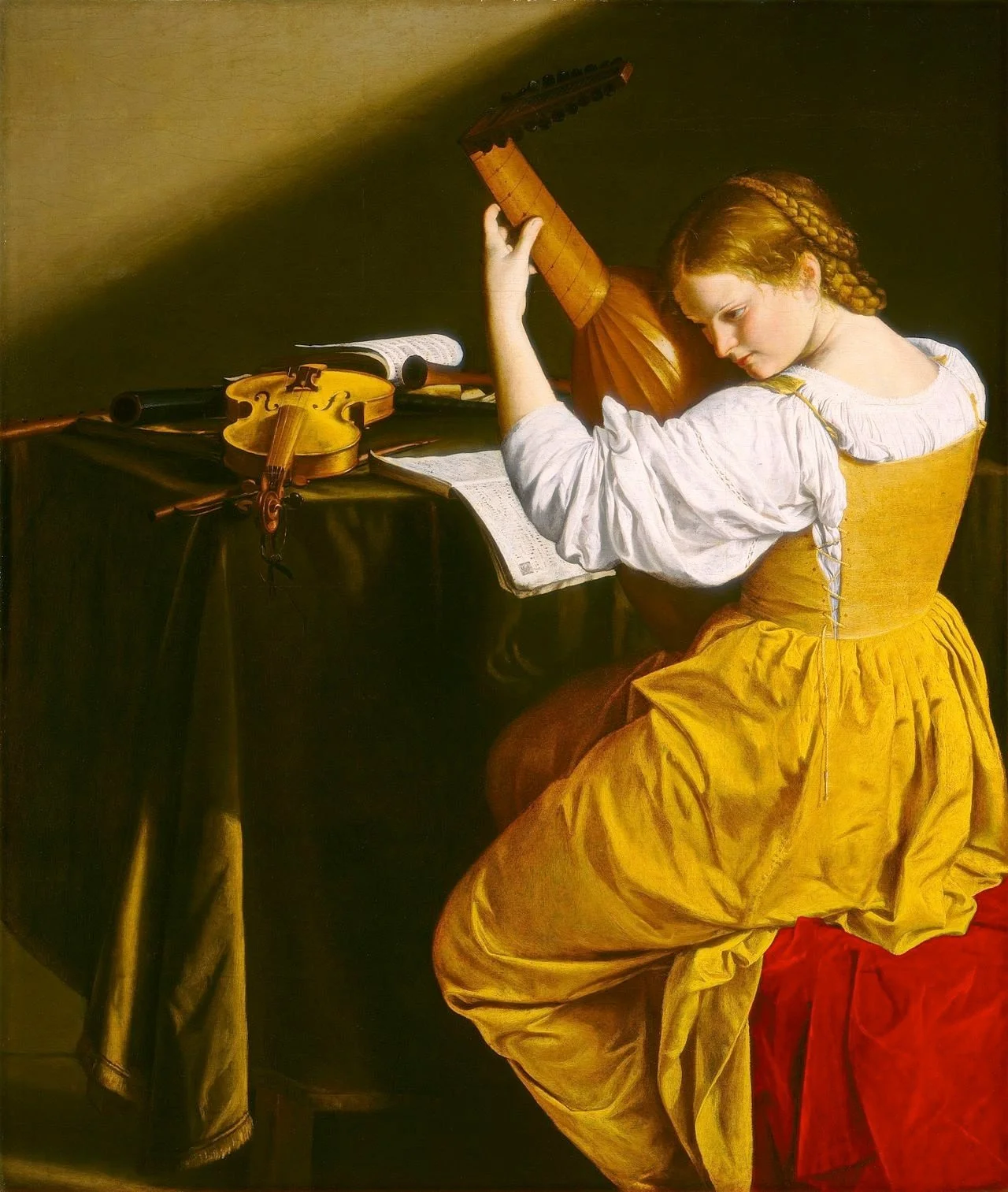
A Baroque depiction of music and intimacy.
The Lute Player by Orazio Gentileschi, c. 1612–1614, oil on canvas (National Gallery of Art, Washington, D.C.)
Cosimo Bottegari, a Florentine musician at the Tuscan court, included in his lute book an arrangement for solo voice and lute of ⏵︎ “Lieta vivo et contenta”. The six-voice madrigal was printed in La ruzina, canzone di Filippo de Monte, insieme un’altra di Cipriano de Rore, et altri madrigali de diversi famosissimi autori a sei voci (Venice: Angelo Gardano, 1591), where it is associated with Cipriano de Rore. Bottegari labeled the piece di Autore Incerto, while a later hand added idest Sra Isabella Medici. The significance of this addition remains uncertain, but it associates the piece with Isabella de’ Medici, herself an accomplished musician and poet.
Similarly, ⏵︎ “Per pianto la mia carne”, in the same lute book, bears the heading “Della Illus.ma et Ecc.ma S.ra Leonora Orsina Duchessa di Segni.” Whether this heading implies attribution or dedication remains uncertain. It therefore cannot be definitively established whether Leonora composed the piece or whether it was dedicated to her. In either case, the headings attest to the close involvement of noblewomen in musical composition and patronage.
Lucia Quinciani's ⏵︎ “Udite lagrimosi spirti d'Averno” was published in Venice in Marc'Antonio Negri's anthology Affetti amorosi (1611). It is the first known published solo monody by a woman composer.
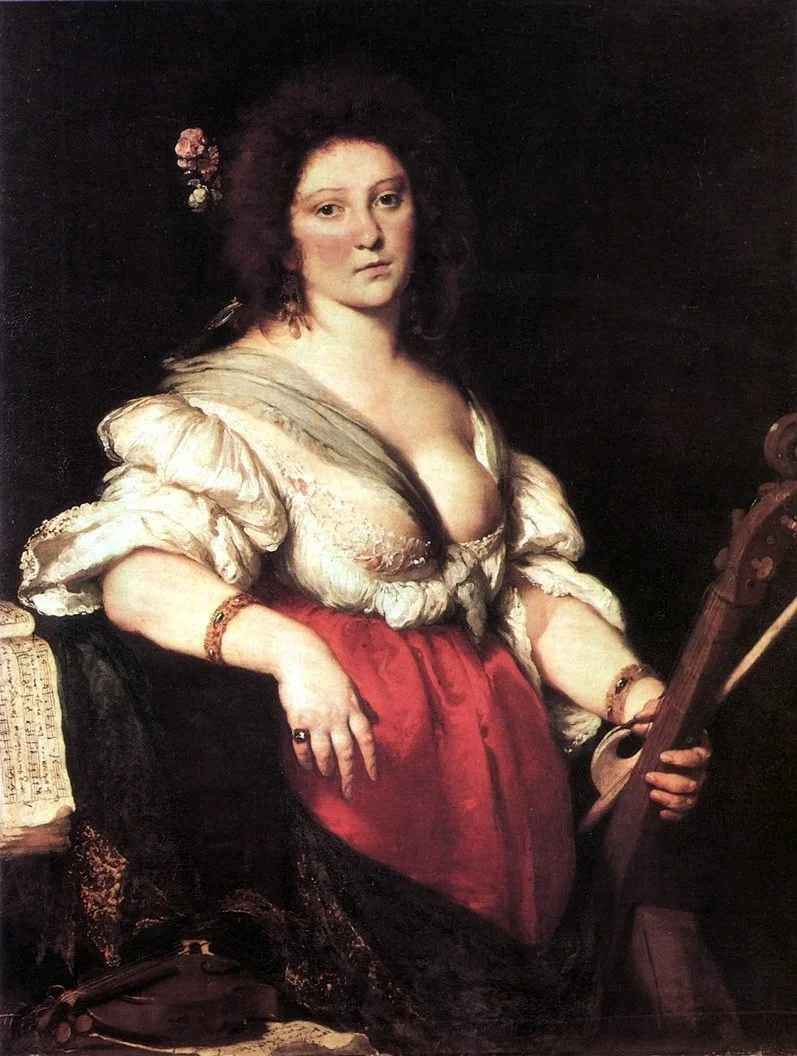
“The Viola da Gamba Player,” portrait of Barbara Strozzi, by Bernardo Strozzi, c. 1630s.
Numerous women known primarily as singers are also reported to have composed music for their own use. Francesca and Settimia Caccini, for example, were credited with composing pieces that they themselves sang.
Francesca Caccini’s ⏵︎ “Maria, dolce Maria” is a song in praise of the Virgin Mary in her role as a comforter. The basso continuo proceeds largely in slow-moving harmonic changes, with rhythmic variation used sparingly. Chromaticism and several dissonances subtly increase the tension. The harmonic climax comes on the phrase “ogni affano acqueta,” where a strong discord expresses anguish before resolving into the soothing cadence.
As Suzanne Cusick observes, Caccini's music represents the Virgin's motion through celestial space as bringing this particular song into being—as composing it. Like most early seicento Florentine sonnet settings, ⏵︎ “Chi è costei” is a modified strophic song that textually and musically moves from a problem (in this case the question) to its resolution (in this case the confirmation that the text speaks as the “Court of paradise”) through subtle variations on a single set of harmonic and motivic ideas.
Francesca Caccini's ⏵︎ “Lasciatemi qui solo” is another notable work from the era, a lament sung from the perspective of a man mourning the loss of his lover. As Cusick notes, Francesca crafted a strophic song that fused Monteverdi's opening gestures with her own mastery of tonal desire. Above a glacially slow bass line and harmonic rhythm, the singer first asks for solitary death in the mid-range. Falling very slowly through successive phrases, the singer's voice reaches what will come to seem, in later stanzas, like its inevitable goal—the quoted refrain “lasciatemi morire.”
Writing about Settimia Caccini, Jacopo Cicognini remarked, as quoted by Suzanne Cusick: “The music of the aforementioned songs was composed by the same women who sang them: (...) the second with exquisite refinement by Signora Settimia, (...) being the daughter of the renowned Giulio Romano.” A number of songs accompanied by basso continuo composed by Settimia Caccini have indeed been preserved in two associated manuscripts, alongside compositions by her husband Alessandro Ghivizzani. Examples include ⏵︎ “Già sperai” from Ariette in musica da diversi maestri, Lobkowicz Music Collection, MS II La 2, and ⏵︎ “Due luci ridenti” from I-Bc MS Q49.
Strozzi's publication history is particularly significant in the context of seventeenth-century Venice, where opportunities for women to establish themselves publicly as composers were limited. Over the course of her career, Strozzi issued eight numbered collections of predominantly vocal music, seven of which survive, creating an unusually substantial printed legacy under her own name. She concludes her Sacri musicali affetti in the deferential language characteristic of seventeenth-century dedications: “on the lightest leaves, I fly in devotion to bow down before you.” Barbara Strozzi's Marian motets ⏵︎ “O Maria” and ⏵︎ “Salve Regina” approach devotion to the Virgin Mary in different ways. “O Maria” praises Mary through a succession of biblical images and recurring invocations, while “Salve Regina” sets the traditional Marian antiphon, moving from praise to supplication and the image of humanity mourning in a “valley of tears.”
Francesca Campana Romana, a singer, instrumentalist, and composer active in Rome, published her Arie in 1629. The collection includes the monody ⏵︎ “Semplicetto Augellin”. Her career places her among the several seventeenth-century women who combined performance and composition.
Antonia Bembo’s ⏵︎ “Lamento della Vergine” addresses the Crucifixion from the perspective of the Virgin Mary. The cantata opens in F minor, a tonal area that contributes to the atmosphere of distress. Its key signature recalls the alternative signature of ⏵︎ “Habbi pietà di me” and appears nowhere else in Produzioni armoniche. As Claire Fontijn observes, the cantata contains twelve sections, with the actual lament appearing in the sixth section as its literal centerpiece. Fontijn suggests that Bembo modeled the work on Barbara Strozzi's Il Lamento, Op. 2 (1651), which dramatizes the execution of Henri de Cinq-Mars in 1642.
While the Italian works testify to the composer’s skill in setting her own language to music, two groups of pieces in Produzioni armoniche show the influence of the French soundscape. The French air ⏵︎ “Ha, que l’absence” joins the tradition of popular urban song in Paris at the turn of the eighteenth century. The final piece in the manuscript, and its only one in French, follows the musical and textual conventions of the airs sérieux et à boire.
A significant number of seventeenth-century women composers were nuns, particularly in the musically active convents of northern Italy. Composers such as Lucrezia Orsina Vizzana, Chiara Margarita Cozzolani, and Rosa Giacinta Badalla published their music, while convent performances could also attract audiences from outside the religious community.
Lucrezia Vizzana's Componimenti musicali includes several motets that draw on the language of spiritual intimacy, presenting Christ as redeemer, savior, and heavenly spouse. Her ⏵︎ “O magnum mysterium” turns the familiar opening words of the Christmas responsory toward a contemplation of Christ's suffering, dwelling on his wounded body and the mystery of divine love.
Isabella Leonarda’s ⏵︎ “Ave suavis dilectio”, a solo motet from her Op. 6 (1676), is scored for soprano, two violins, and continuo. Its highly ornamented vocal writing, expressive word painting, and instrumental ritornelli reflect the stile moderno cultivated in seventeenth-century sacred music.
Rosa Giacinta Badalla was a nun at the convent of Santa Radegonda in Milan. Laypersons attended convent musical performances to hear the “disembodied voices” of the nuns emanating from behind convent screens. Her motet ⏵︎ “Non plangete”, written Per la Natività della Beata Vergine Maria, appeared in her only printed collection, Motetti a voce sola (Venice, 1684), and is notable for its demanding vocal writing and strongly defined motivic material.
Donna Bianca Maria Meda's ⏵︎ “Cari musici” from Mottetti a 1, 2, 3, e 4 voci (1691), addresses musicians directly, first asking them to fall silent so that the singer may contemplate the love of Jesus. The text then reverses this request: realizing that love cannot remain silent, the singer calls on the musical voices to sound again.
To further explore these works, you can listen to my YouTube playlist ⏵︎ “Women Composers from the Baroque Era”, featuring score animations with transcriptions available for purchase on my website. Many of these works remain far less familiar than those of their male contemporaries. Making them available in modern editions allows them to be approached not merely as curiosities of women's musical history, but as part of the broader repertory of seventeenth-century music.
References
Bottegari, Cosimo. (1965). The Bottegari Lutebook. Edited by Carol MacClintock. The Wellesley Edition, no. 8. Wellesley College.
Bowers, Jane M. (1986). “The Emergence of Women Composers in Italy, 1566–1700.” In Jane M. Bowers and Judith Tick (eds.), Women Making Music: The Western Art Tradition, 1150–1950, 116–167. University of Illinois Press.
Bridges, Thomas W. (2001). “Quinciani, Lucia.” In Grove Music Online. Oxford University Press.
Cusick, Suzanne G. (2015). Francesca Caccini at the Medici Court: Music and the Circulation of Power. University of Chicago Press.
D’Accone, Frank A. (2003). “Corteccia’s Motets for the Medici Marriages of 1558.” In David Rosen and Claire Brook (eds.), Words on Music: Essays in Honor of Andrew Porter on the Occasion of His 75th Birthday, 36–73. Pendragon Press.
Dunbar, Julie C. (2020). Women, Music, Culture: An Introduction. Routledge.
Fontijn, Claire. (2006). Desperate Measures: The Life and Music of Antonia Padoani Bembo. Oxford University Press.
Kendrick, Robert L. (1994). “Four Views of Milanese Nuns’ Music.” In E. Ann Matter and John Coakley (eds.), Creative Women in Medieval and Early Modern Italy: A Religious and Artistic Renaissance, 324–342. University of Pennsylvania Press.
Monson, Craig A. (1994). “The Making of Lucrezia Orsina Vizzana’s Componimenti Musicali (1623).” In E. Ann Matter and John Coakley (eds.), Creative Women in Medieval and Early Modern Italy: A Religious and Artistic Renaissance, 297–323. University of Pennsylvania Press.
Pecknold, Sara Michael. (2021). “Madre d’Amore: Redemptive Motherhood in Barbara Strozzi’s Sacri musicali affetti (1655).” Journal of Seventeenth-Century Music, 27(2).
Pelliccia, Chiara. (2024). “Nuove acquisizioni su Francesca Campana, compositrice e «maestra nell’arte» musicale.” Recercare, 36, 63–87.
Raney, Carolyn. (1965). “Introduction to Francesca Caccini.” The NATS Bulletin, 22, 12–15.
Weaver, Elissa B. (2002). Convent Theatre in Early Modern Italy: Spiritual Fun and Learning for Women. Cambridge University Press.