17th Century Italian Laments
The lament became one of the most prominent vehicles for expressive solo song in seventeenth-century Italy. Closely associated with the development of monody and opera, it offered composers a flexible framework for representing grief, abandonment, anger, and despair. Early examples often unfold as extended recitative or arioso, while later settings increasingly incorporate aria-like sections, recurring bass patterns, and more clearly differentiated formal divisions.
The subjects of these works vary considerably. Classical heroines such as Ariadne provided an important model, but the lament was also adapted to religious, historical, and amorous contexts. Despite this variety, many settings share an emphasis on heightened declamation, harmonic tension, repetition, and the close relationship between musical gesture and the changing emotional states of the text.
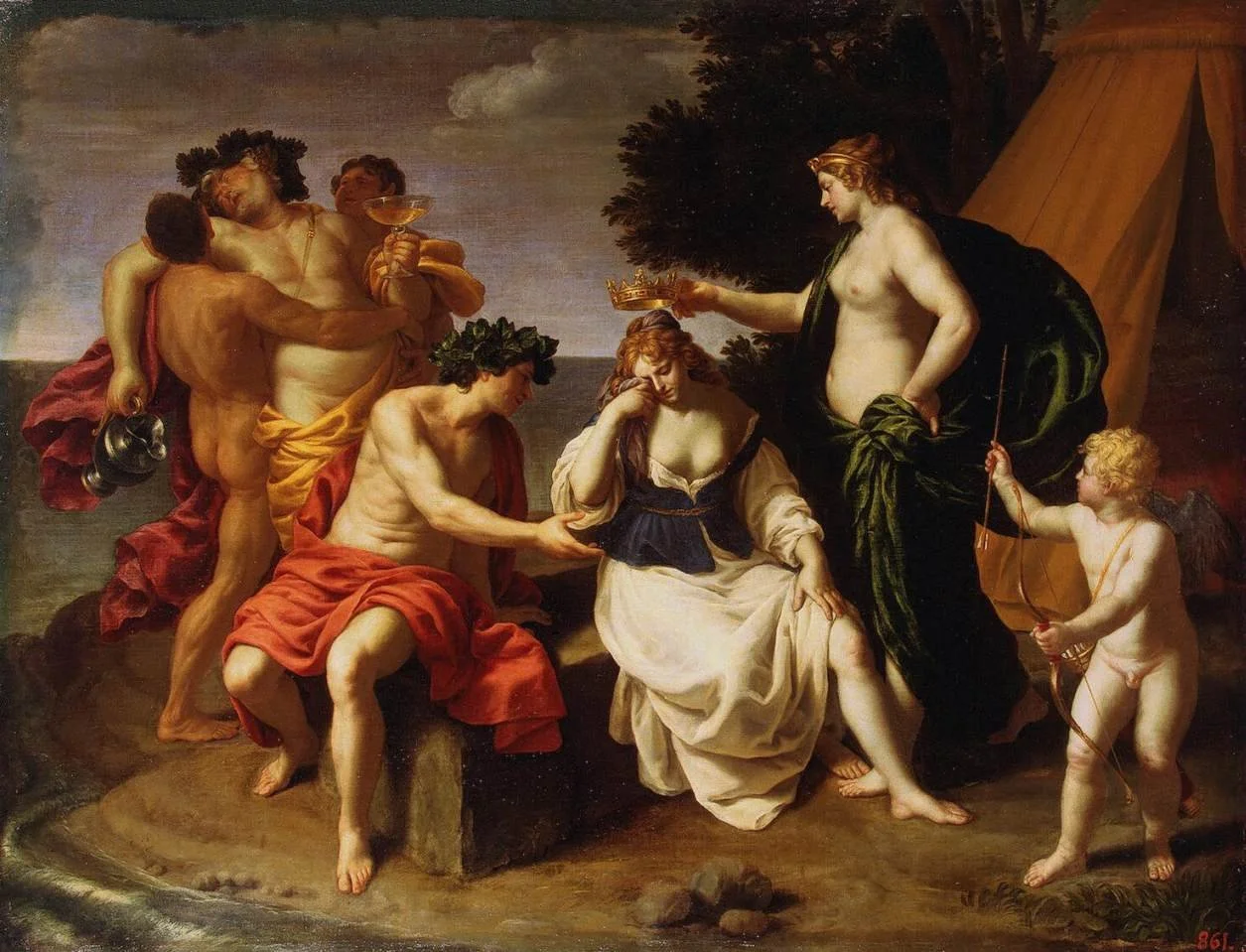
Alessandro Turchi (L’Orbetto), Bacchus and Ariadne, c. 1630 (National Gallery Prague).
Monteverdi's ⏵︎ Lamento d'Arianna, the only surviving music from his opera L’Arianna (1608), became an important model for later seventeenth-century laments. Set to a text by Ottavio Rinuccini, it presents Ariadne after her abandonment by Theseus on the island of Naxos. The monodic version was published separately in Venice in 1623.
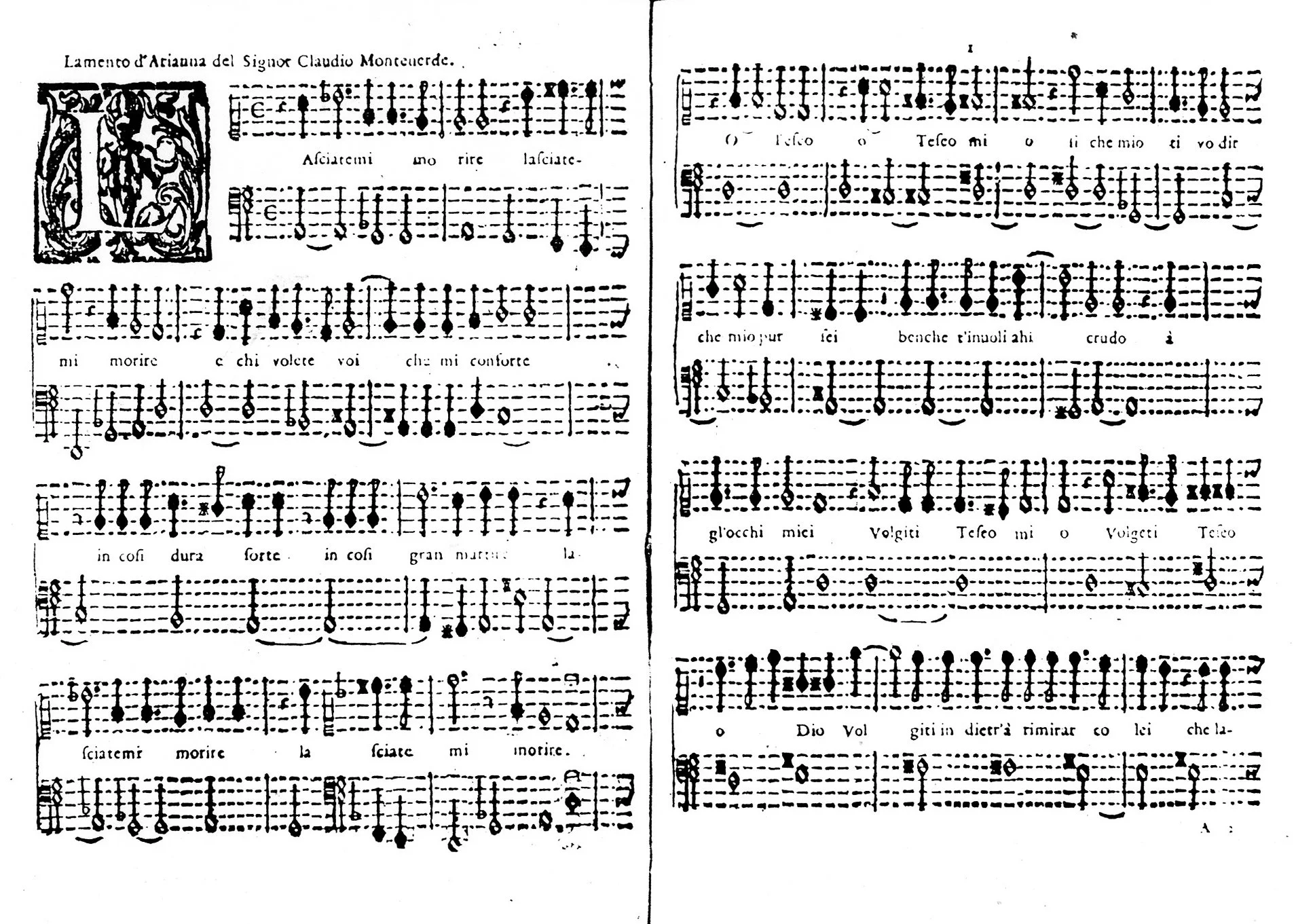
Claudio Monteverdi, Lamento d’Arianna, first two pages of the Venetian edition (1623).
Monteverdi employs contrasting styles of declamation in response to Ariadne’s changing emotional states. In both statements of “lasciatemi,” dissonances between voice and bass intensify the sense of anguish, while elsewhere repeated pitches in the vocal line are supported by relatively static harmonies. Ariadne’s outburst of anger in the fourth section is again marked by repeated-note declamation, but the vocal line now rises and accelerates, culminating in rapid semiquavers at “le voragini profonde.” The passage departs from the harmonic stability of the surrounding music, reinforcing the change from grief to rage.
The musical and textual procedures of Lamento d’Arianna—especially its flexible declamation and succession of contrasting emotional states—were taken up in numerous later laments based on classical heroines.
A notable later setting of Ottavio Rinuccini’s text is Francesco Antonio Costa’s ⏵︎ Pianto d'Arianna, published in Venice in 1626. Costa employs a slow-moving bass, generally changing harmony only once or twice within each poetic line, beneath a vocal part that is predominantly stepwise or based on repeated pitches. The setting also incorporates ornamental devices such as the trillo, recurring cadential figures, and a brief passage in triple metre.
Costa abridges Rinuccini’s text, making cuts immediately before and after Ariadne’s outburst of rage. As a result, her anger is set apart more clearly as a distinct musical and dramatic section.
As the cantata developed during the 1630s and 1640s, particularly in Rome, the lament was increasingly incorporated into forms that alternated recitative with more lyrical arioso or aria-like sections. Giacomo Carissimi’s ⏵︎ “Ferma, lascia ch’io parli”, commonly known as the Lamento di Maria Stuarda, illustrates this development. One surviving source, British Library Harley MS 1265, identifies the work as the lament of Mary, Queen of Scots and attributes it to Carissimi. Another manuscript, preserved in the Biblioteca Angelica in Rome, attributes the text to Giovanni Filippo Apolloni.
The cantata imagines Mary addressing her executioner shortly before her death. It begins with an extended recitative in which she asserts her innocence and confronts the injustice of her sentence. This gives way to an aria in triple metre beginning “A morire,” before the music returns to recitative. In the aria, Mary declares that crowns are no longer of any avail in preserving justice and faith when ragion di stato can make even truth lie. The final recitative turns first to her ladies-in-waiting and then to London and Elizabeth I, whom the text calls a “second Jezebel.” In its closing lines the perspective shifts from Mary’s first-person speech to narration, recounting her execution and the union of her soul with God.
The recitative sections move through a comparatively wide range of harmonies, while the central aria provides a more stable contrast. Much of the vocal writing is syllabic, but several melismas draw attention to particular words. Especially striking is the extended setting of “vaglion” in the phrase “più non vaglion le corone”: here vaglion means “are of value” or “are of avail,” not “no longer.” Together with the melisma on “serbar” (“to preserve”), the passage emphasizes the failure of royal status to protect justice and faith.
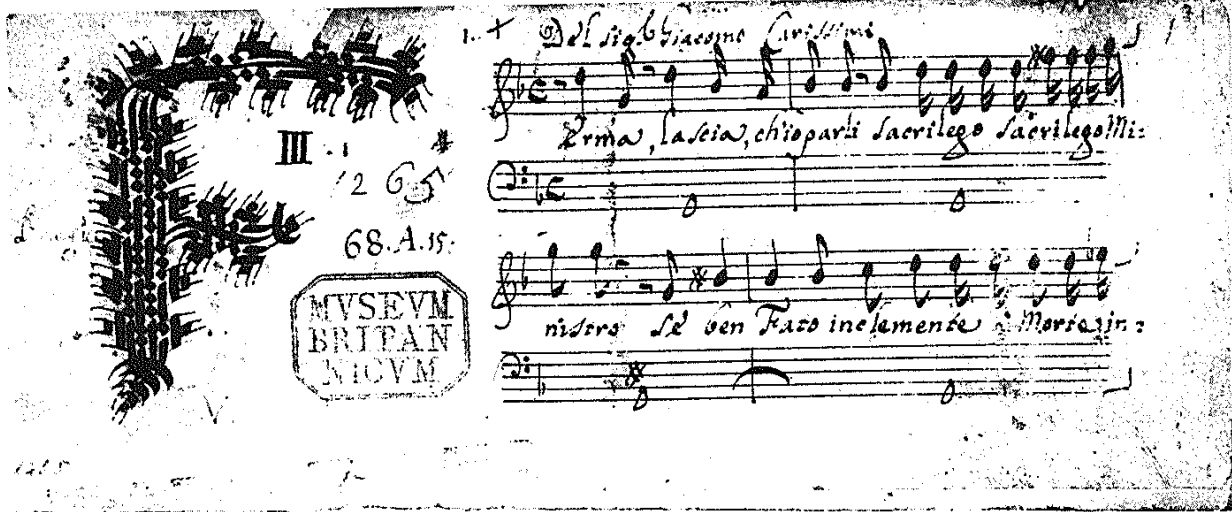
Giacomo Carissimi, Lamento di Maria Stuarda (“Ferma, lascia ch’io parli”), British Library, Harley MS 1265, f. 1r.
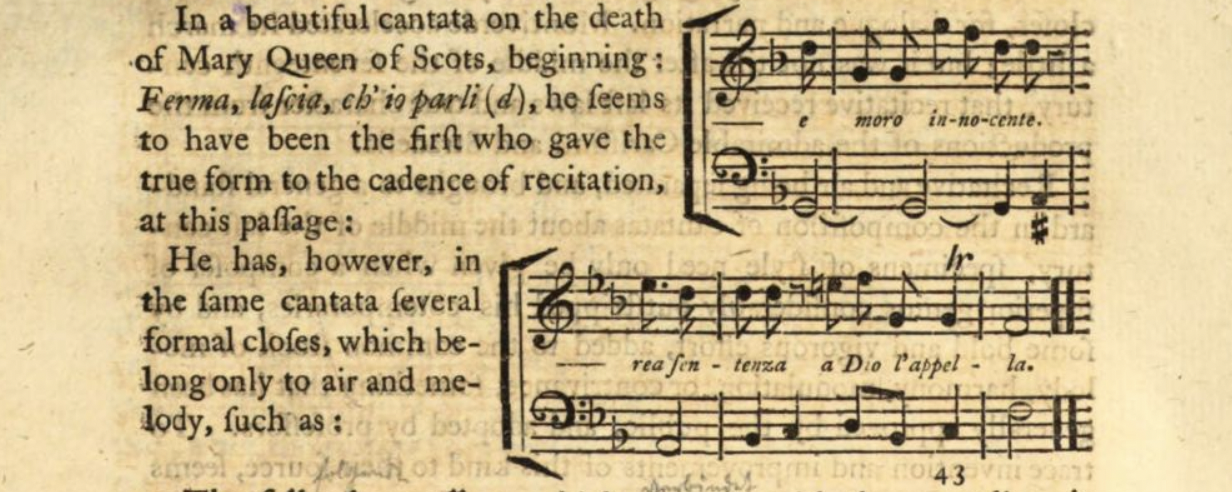
Charles Burney, A General History of Music, vol. 4 (London, 1789), including musical extracts from Carissimi’s Lamento di Maria Stuarda.
A different type of lament appears in Monteverdi’s ⏵︎ Lamento della Ninfa, published in his Madrigali guerrieri, et amorosi (1638). The work is framed by three male voices who introduce the scene, comment on the nymph’s suffering, and return at the end. The central lament itself is sung by a solo soprano over a continuously repeating descending tetrachord in the bass.
This four-note descent, A–G–F–E, functions as a ground bass beneath the nymph’s free and irregular vocal line. The contrast between the unchanging ostinato and the flexibility of the voice allows Monteverdi to preserve the sense of spontaneous lament while maintaining a clearly audible structural foundation. The male voices periodically interject with the refrain “Miserella,” commenting on the nymph’s distress from outside her first-person lament.
The descending tetrachord subsequently became closely associated with lament. Ellen Rosand famously described it as an “emblem of lament”: the pattern appears repeatedly in seventeenth-century vocal music, sometimes diatonically, as in Monteverdi’s setting, and sometimes chromatically. Its later use in works such as Purcell’s ⏵︎ “When I am laid in earth” demonstrates how durable this musical association became.
The descending tetrachord soon became a recurring device in vocal laments and related arias. Giovanni Felice Sances’s ⏵︎ “Usurpator tiranno” (1633), explicitly described as a cantada sopra il passacaglie, is built over a descending tetrachord in the bass. Later examples include Francesco Cavalli’s ⏵︎ “Lasso io vivo” from L’Egisto (1643), Luigi Pozzi’s ⏵︎ “Così dal lungo sangue sparso” from L’innocenza de’ ciclopi (1654), and Antonio Cesti’s ⏵︎ “Disserratevi abissi” from L’Argia (1655). In these works the pattern may appear in diatonic or chromatic form, but its persistent downward motion provides a recognizable structural basis for expressions of grief, abandonment, and despair.
These examples illustrate the variety of forms assumed by the lament in seventeenth-century Italian music, from the extended recitative of Monteverdi’s Lamento d’Arianna to cantata-like structures and arias built over recurring bass patterns. Rather than constituting a single fixed musical form, the lament provided composers with a flexible means of responding to texts of grief, abandonment, anger, and loss. Its changing musical conventions also reflect broader developments in seventeenth-century vocal music, particularly the emergence of monody, opera, and the cantata.
A selection of these works can be heard in my YouTube playlist ⏵︎ “17th Century Italian Laments”, with transcriptions available through Early Music Scores.
References
Bianconi, Lorenzo. (1987). Music in the Seventeenth Century. Translated by David Bryant. Cambridge University Press.
British Library. Harley MS 1265, ff. 1r–12v.
Burney, Charles. (1789). A General History of Music, from the Earliest Ages to the Present Period, vol. 4. London: Printed for the Author.
Carter, Tim. (1999). “Lamenting Ariadne?” Early Music, 27(3), 395–406.
Carter, Tim. (2007). “Intermedio IV: Lamento della ninfa (1638).” In John Whenham and Richard Wistreich (eds.), The Cambridge Companion to Monteverdi, 195–198. Cambridge University Press.
Costa, Francesco Antonio. (1626). Pianto d’Ariana, madrigali, e scherzi … a voce sola, Op. 3. Venice: Alessandro Vincenti.
Giannelli, Matteo. (n.d.). “Ferma lascia ch’io parli / Carissimi, Giacomo.” Clori: Archivio della Cantata Italiana, record 12492.
Rosand, Ellen. (1979). “The Descending Tetrachord: An Emblem of Lament.” The Musical Quarterly, 65(3), 346–359.
Rosand, Ellen. (1991). Opera in Seventeenth-Century Venice: The Creation of a Genre. University of California Press.
Rosand, Ellen. (2001). “Lamento.” Grove Music Online. Oxford University Press.