La bella peccatrice: 17th-Century Cantatas on Mary Magdalene

Titian, The Penitent Magdalene, 1531–1535, oil on canvas (Palatine Gallery, Pitti Palace, Florence).
Mary Magdalene occupied a prominent place in seventeenth-century devotional literature and music. In the Western Christian tradition, her biblical identity had gradually become intertwined with those of Mary of Bethany and the unnamed sinful woman who anointed Christ’s feet, producing the familiar image of Magdalene as both repentant sinner and devoted follower of Christ. This composite figure offered composers a range of dramatic situations: her conversion and penitence, her presence at the Crucifixion, her mourning for Christ, and the later tradition of her solitary life in Provence.
These themes appear frequently in seventeenth-century Italian vocal music, particularly in monodies and solo cantatas. Composers such as Luigi Rossi, Girolamo Frescobaldi, and Domenico Mazzocchi approach Magdalene through different aspects of this devotional tradition, from penitence and contemplation to grief at the death of Christ. The works discussed here illustrate some of the ways in which her figure was adapted to the expressive language of seventeenth-century solo song.
Luigi Rossi composed three cantatas centered on Mary Magdalene: ⏵︎ Pender non prima vide, O grotta, o speco, o sasso, and ⏵︎ Un allato messaggier. Each approaches a different aspect of her devotional image.
“Pender non prima vide,” also known as the Pianto della Maddalena, depicts Mary mourning at the foot of the Cross. Its structure resembles that of many seventeenth-century secular laments: a narrator introduces the scene before giving way to Magdalene’s extended first-person monologue, and returns at the end in a section explicitly marked “Aria.” The text contains relatively few details specific to Magdalene, although references to her hair drying Christ’s feet and to the vanity of her former beauty connect the lament with established aspects of her iconography.
“O grotta, o speco, o sasso” turns instead to the later legend of Magdalene’s penitential life in the cave of Sainte-Baume in Provence. The text presents her withdrawing from the world, lamenting her former sins, and seeking divine forgiveness. Rossi’s setting is predominantly recitative-like; its opening invocation, “O grotta, o speco, o sasso,” rises melodically, a gesture that recurs as a characteristic feature of the composition. The poem also draws on familiar symbols of the penitent Magdalene, including her hair, tears, the mirror associated with former vanity, and the skull as a memento mori.

Annibale Carracci, Mary Magdalene in a Landscape, c. 1599, oil on copper (Fitzwilliam Museum, Cambridge).
⏵︎ Un allato messaggier is different again: it is a sacred contrafactum of Rossi’s secular lament ⏵︎ Un ferito cavaliero, originally written for the Queen of Sweden mourning the death of her husband, Gustavus Adolphus. In the contrafactum, a winged messenger announces Christ’s death to the “divine woman,” after which Magdalene expresses her grief in the first person. Much of the original secular text is retained, with essential references altered from queen and king to Magdalene and Christ. The adaptation therefore places the language and musical gestures of secular bereavement within a devotional context.
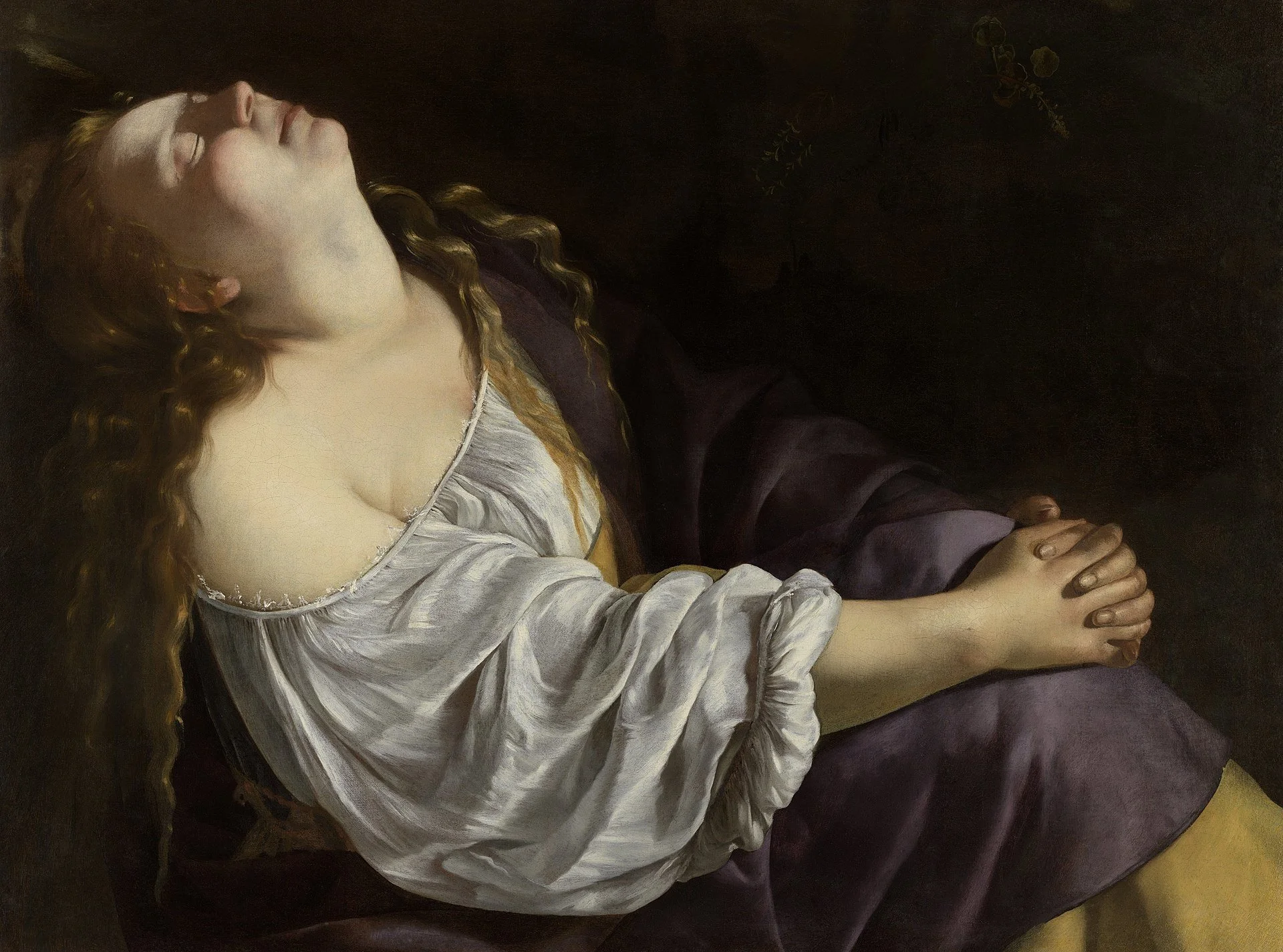
Artemisia Gentileschi, Mary Magdalene in Ecstasy, c. 1625, oil on canvas (National Gallery of Art, Washington, D.C.).
Girolamo Frescobaldi’s ⏵︎ A piè della gran Croce (Maddalena alla Croce), published in his Primo libro d’arie musicali (1630), is a sonetto spirituale for solo voice. The poem places Magdalene at the foot of the Cross, where she watches the dying Christ and asks how she can continue to live without him.
The text presents her grief in language that often resembles the lament of a lover for the beloved. She appears with disheveled hair and flowing tears and is described as Christ’s “faithful grieving lover” (fedele addolorata amante). Only in the closing lines does the devotional context become explicit, when she addresses Christ as “my Redeemer, my God” and declares that she must share both life and death with him. As Teresa Gialdroni observes, the poem therefore draws more strongly on the language of personal bereavement than on a conventional profession of faith.
Frescobaldi sets the sonnet for solo voice in a predominantly declamatory manner, allowing the changing rhythm and inflection of the verse to shape the musical line. The result places particular emphasis on Magdalene’s direct speech in the final six lines, where the descriptive narration gives way to her questions and declaration of union with Christ.
Domenico Mazzocchi’s ⏵︎ Lagrime amare (La Maddalena ricorre alle lagrime), published in his Dialoghi e sonetti (Rome, 1638), presents Magdalene simply in the act of weeping. Unlike works that place her at the Cross, the tomb, or in the cave of Sainte-Baume, the sonnet provides no specific narrative setting. Instead, her identity is conveyed through tears, one of the most characteristic elements of her seventeenth-century iconography.
The text gives these tears a penitential and redemptive function. Magdalene calls on them to heal the wound inflicted on the soul by the “cruel serpent of Hell” and links their cleansing power with the blood of Christ. Mazzocchi follows the structure of the poem by alternating recitative-like and arioso sections, frequently using madrigalisms and coloratura to emphasize particular words and images. The final tercet gives especially prominent musical treatment to the flowing of the tears, bringing together the physical act of weeping and its spiritual significance.
Monteverdi’s ⏵︎ Lamento d’Arianna also circulated in spiritual contrafacta. The best-known is the ⏵︎ Pianto della Madonna (Iam moriar, mi fili), a Latin adaptation in which Ariadne’s lament becomes the Virgin Mary’s mourning for Christ. Monteverdi included the work in his Selva morale e spirituale (Venice, 1640–41), giving the transformation an authorized place within his own sacred music.
A less familiar adaptation, the ⏵︎ Lamento della Maddalena, survives in Bologna, Museo internazionale e biblioteca della musica, MS Q.43. Here Ariadne is replaced by Mary Magdalene. The dramatic setting is less explicit than in the Pianto della Madonna: Linda Maria Koldau and Teresa Gialdroni suggest that the text may evoke Magdalene at the Ascension rather than at the Crucifixion. A second Magdalene contrafactum survives in another Bologna manuscript, Lamento della Maddalena, sopra quel d’Ariadna con nuova aggiunta di C. C., where the Ascension setting is more explicit.
These works show how the figure of Mary Magdalene could accommodate a wide range of seventeenth-century devotional subjects: penitence, grief at the Crucifixion, solitary contemplation, and the transformation of secular lament into sacred expression. Rossi, Frescobaldi, Mazzocchi, and the Magdalene contrafacta of Monteverdi’s Lamento d’Arianna draw on different aspects of her composite devotional identity, while repeatedly returning to the imagery of tears, abandonment, repentance, and intimate attachment to Christ.
A selection of these works can be heard in my YouTube playlist ⏵︎ 17th-Century Cantatas on Mary Magdalene, with transcriptions available through Early Music Scores. For further listening, María Cristina Kiehr’s recording Canta la Maddalena with Concerto Soave provides a broader anthology of seventeenth-century Italian music devoted to Magdalene.
References
Gialdroni, Teresa Maria. (2018). “Cantatas on Mary Magdalene, a Sinner and Holy Woman.” In Michael Pauser and Elisabeth Birnbaum (eds.), Denn Musik ist der größte Segen... Festschrift Helen Geyer zum 65. Geburtstag, 61–76. Sinzig: Studio Verlag.
Kiehr, María Cristina; Concerto Soave; Jean-Marc Aymes. (2000). Canta la Maddalena. Harmonia Mundi France, HMC 901698.
Koldau, Linda Maria. (2001). “‘Non sit quid volo sed fiat quod tibi placet’: I contrafacta sacri del Lamento d’Arianna di Claudio Monteverdi.” Rivista Italiana di Musicologia, 36(2), 281–314.