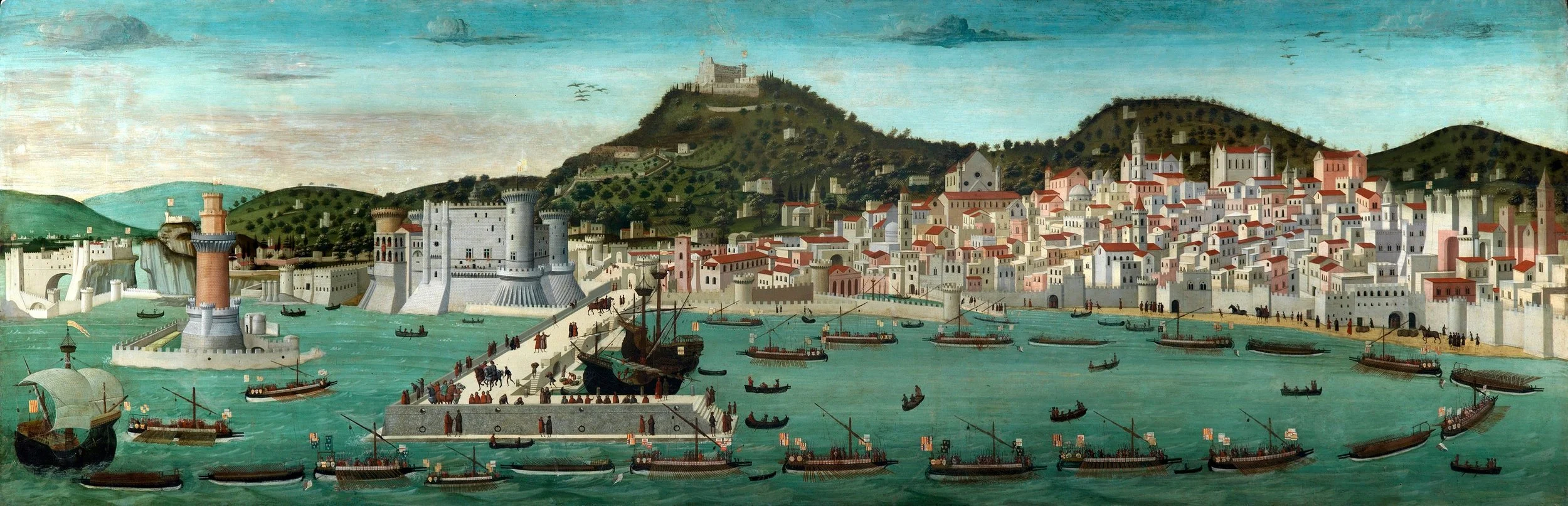
Anonymous artist (sometimes attributed to Francesco Rosselli), Tavola Strozzi (1472–73). Return of the Aragonese fleet after the Battle of Ischia. Museo Nazionale di San Martino, Naples.
O tempo bono is a strambotto written by the Neapolitan humanist poet Francesco Galeota. An anonymous musical setting survives in the songbook Montecassino 871, a major source for sacred and secular repertory associated with the Aragonese court of Naples in the second half of the fifteenth century.
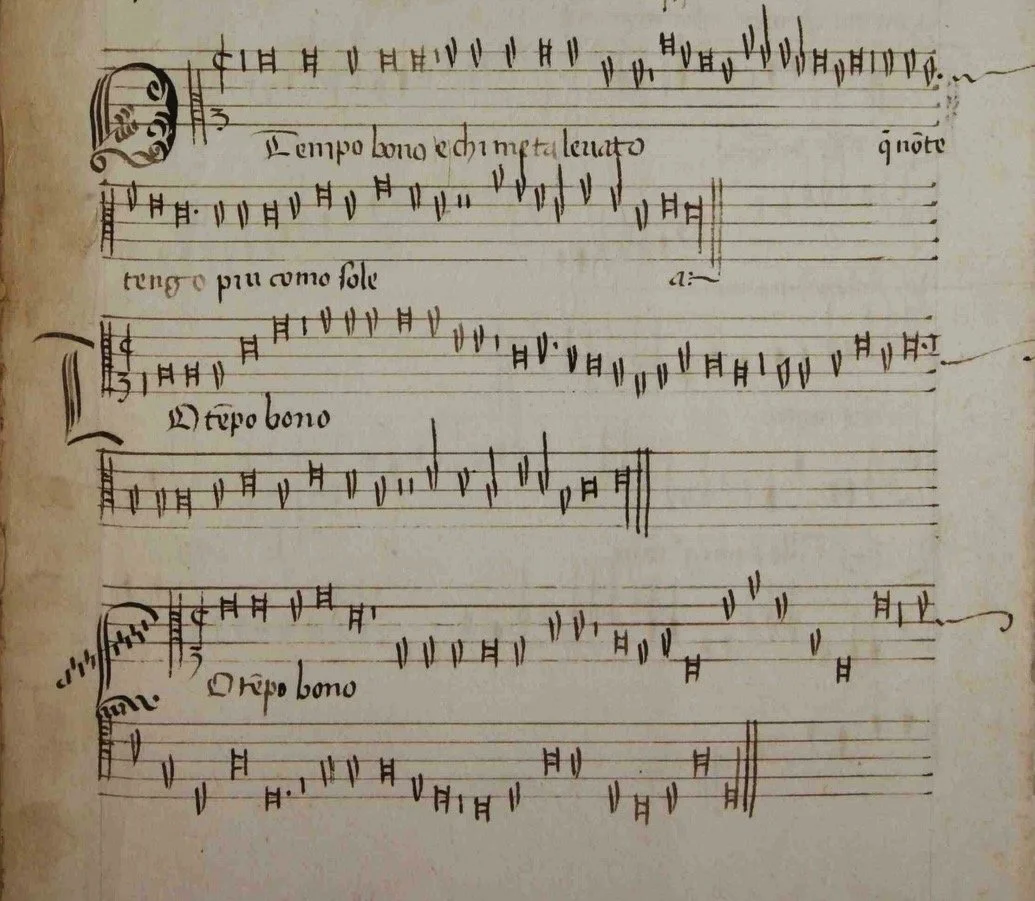
O tempo bono. Montecassino, Biblioteca dell’Abbazia, MS 871, p. 421.
The musical manuscript preserves only the opening couplet. Four complete literary copies survive in three manuscript sources:
Vatican City, Biblioteca Apostolica Vaticana, Vat. lat. 10656 (two copies, ff. 113r–v and 121r);
Modena, Biblioteca Estense e Universitaria, MS It. 1168 (α.M.7.32), f. 67r;
Naples, Biblioteca Nazionale di Napoli, MS XVII.1 (two poetically opposed texts: “O tempo bono, chi me t’ha levato” f. 45v; and “O tempo buono, et come si tornato” f. 86v).
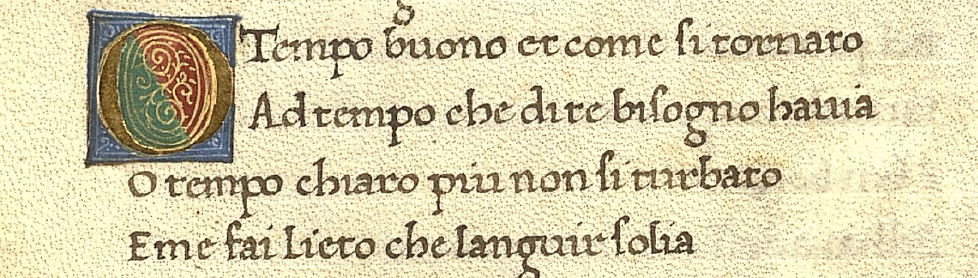
Naples, Biblioteca Nazionale di Napoli, MS XVII.1, f. 86v: O tempo buono et come si tornato, a responding poem to Galeota’s O tempo bono (f. 45v).
A devotional adaptation, “O Jesu buono, come m’hai lassato”, survives in the Florentine print Laude facte & composte da piu persone spirituali (Florence, 1495). The direction “cantasi come O tempo buono” identifies a tune by its incipit. It attests to the circulation of a recognizable song model, although it does not prove that every transmitted version used the surviving Montecassino setting unchanged.
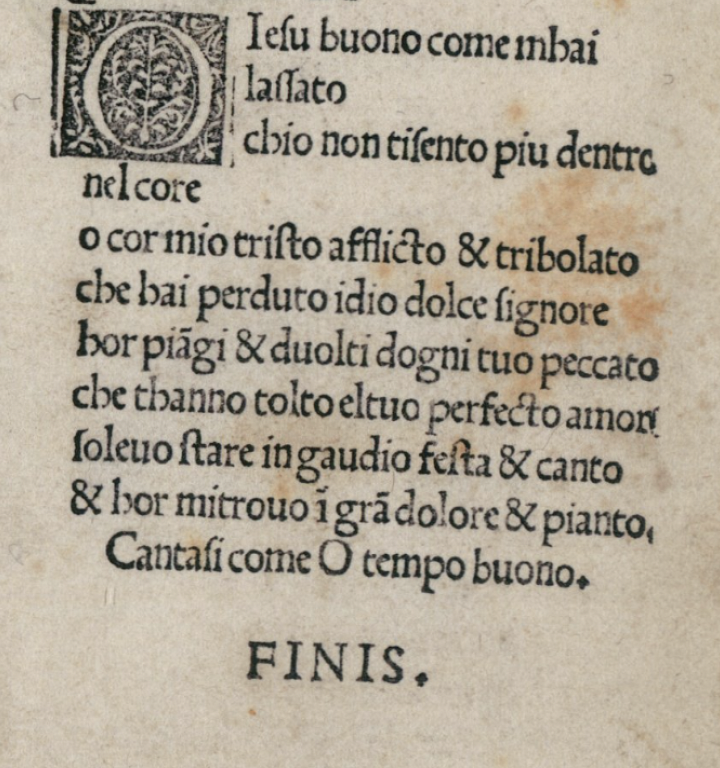
O Jesu buono, from Laude facte & composte da piu persone spirituali, Firenze, 1495.
Rhyme and Meter
The poem is a Sicilian strambotto in ottava form (eight lines), composed of hendecasyllabic verses. In the Modena and Naples copies, the eight line endings form the rhyme scheme:
ABABABAB (solia, havia, via, mia).
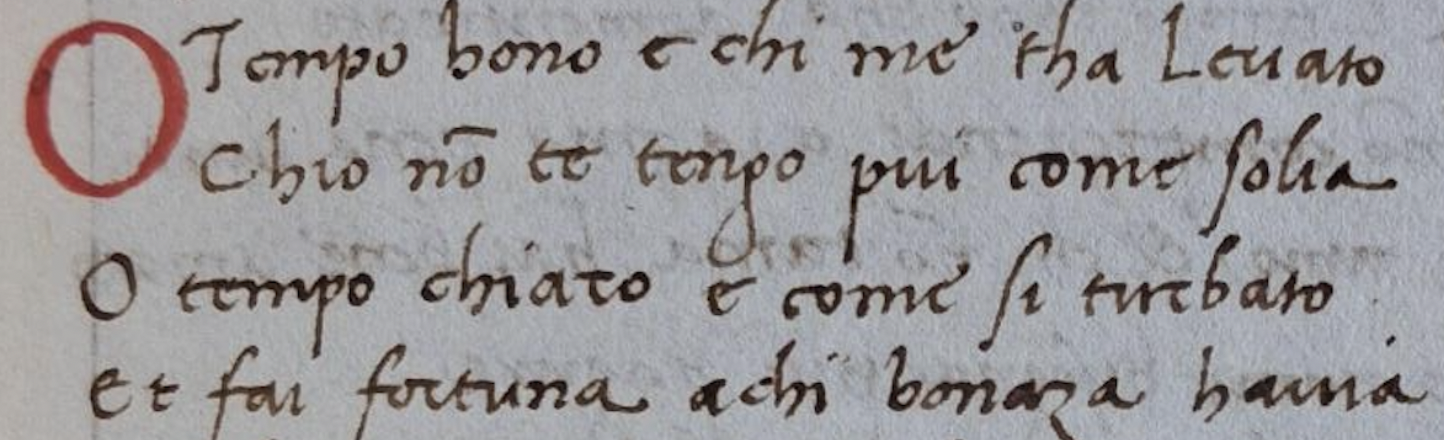
Modena, Biblioteca Estense e Universitaria, MS It. 1168 (α.M.7.32), f. 67r.
The first Vatican copy, and the text underlaid in my edition, instead have the rhyme scheme:
ABABACAC (solea, havea, via, mia).
Montecassino 871 copies only the opening couplet, with solea in line 2. My edition supplies the remaining lines from literary witnesses, including havea from the first Vatican copy. Modena and Naples instead read solia and havia.
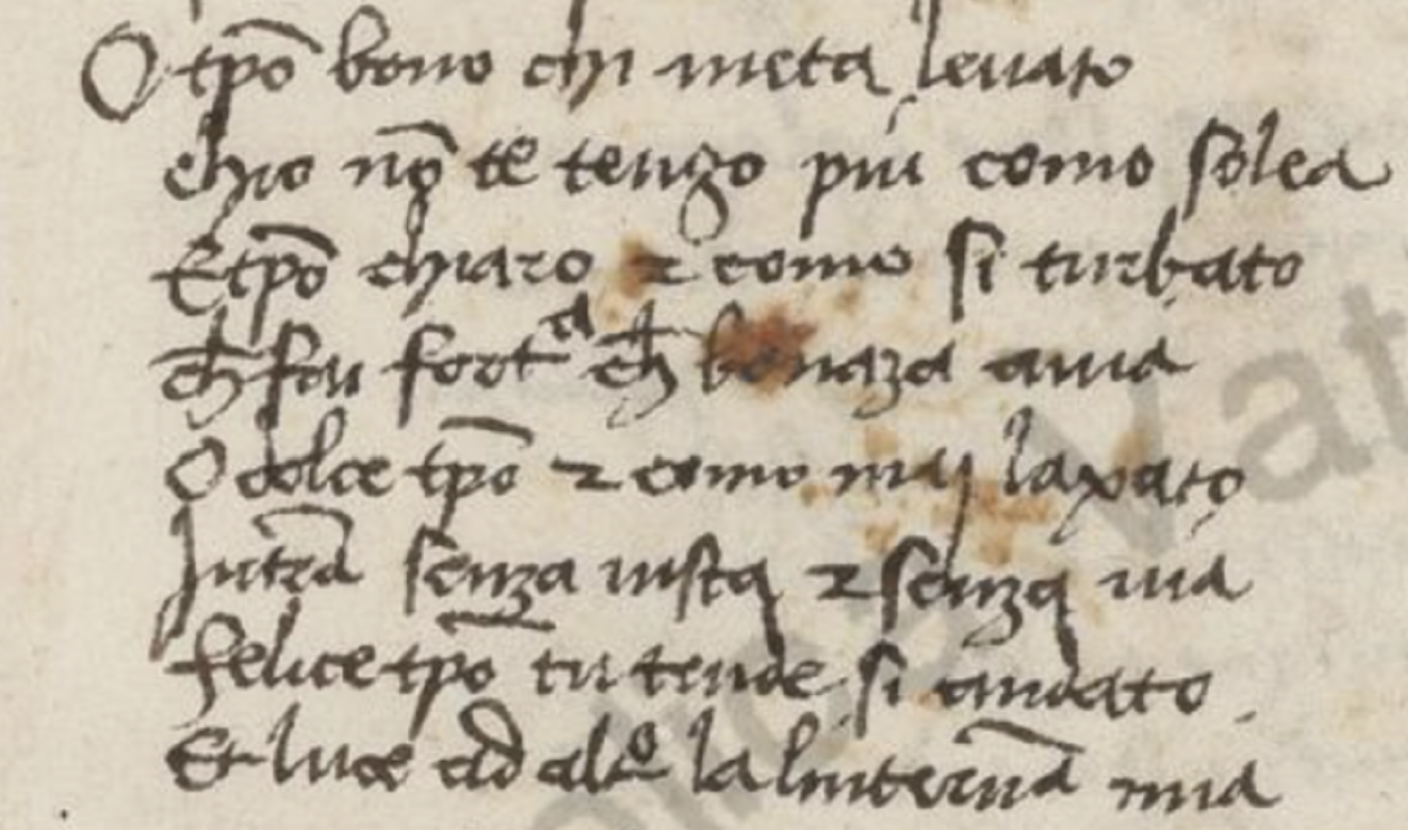
Vatican City, Biblioteca Apostolica Vaticana, Vat. lat. 10656, f. 121r.
Textual Variants
When the sources are compared, numerous textual variants emerge. Through collation, many unclear passages can be clarified, allowing for a more convincing reading of the text. Some readings, especially in the Montecassino incipit, have been interpreted as signs of Iberian linguistic influence (Beltran Pepió 2024, 28), but spelling alone does not identify the origin of an individual scribe: como / come, que / che, laxato / lassato, dolze / dolce.
In verse 6, both copies in Vat. lat. 10656 abbreviate the word as “intra” with a mark above it. Bronzini (1982) gives “intrare” as a possible expansion. Modena and Naples, however, write “in terra” in full; I prefer this editorial reading because it makes better sense of the verse: the lover has been left on land, without sight or a path. In a semi-diplomatic transcription, the abbreviation itself should remain visible.

Modena, Biblioteca Estense e Universitaria, MS It. 1168 (α.M.7.32), f. 67r.
In verse 8 of the first Vatican copy (f. 113v), the text reads “et mo luce ad altro la lenterna mia.” The second Vatican copy (f. 121r), Modena, and Naples omit “mo,” leaving “et luce ad altro” and restoring the hendecasyllabic meter of the verse.

Vatican City, Biblioteca Apostolica Vaticana, Vat. lat. 10656, f. 113v.
Maritime Metaphor
The Italian word tempo can mean both “time” and “weather.” This ambiguity invites a nautical reading of the poem, especially in the contrast between tempo chiaro (“clear weather”) and tempo turbato (“stormy weather”).
Fortuna and bonanza likewise place changing luck beside changing conditions at sea. In the poem’s own sequence, these resonances support a maritime reading without requiring a single literal nautical meaning for every word (Beltran Pepió 2024, 28).

Anonymous artist (sometimes attributed to Francesco Rosselli), Tavola Strozzi (1472–73). View of Naples and the returning Aragonese fleet. Museo Nazionale di San Martino, Naples.
In the Naples source, it reads bonaccia instead of bonaza/bonanza. Both forms evoke calm at sea as well as a happier condition; set against fortuna, the reading reinforces the poem’s opposition between storm and calm.
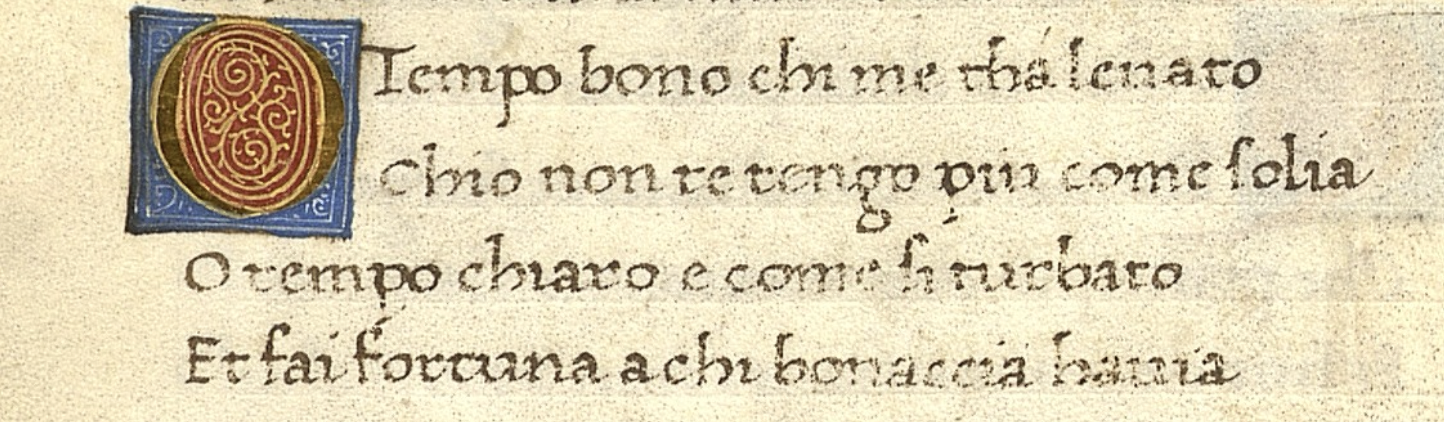
Naples, Biblioteca Nazionale di Napoli, MS XVII.1, f. 45v.
The line “lassato in terra senza vista et sensa via” (“left on land without sight and without a path”) further clarifies the maritime metaphor, evoking a sense of being stranded.
The final line, “e luce ad altro la lanterna mia”, returns to this symbolic register: the poet’s guiding light (or harbor light) now shines for another.
In Italian poetry, the topos of the “ship of love” is well-established, as seen in the influential sonnet Passa la nave mia colma d’oblio by Petrarch.
Translation
The word tempo carries two meanings, referring simultaneously to “time” and “weather,” while fortuna and bonanza carry both figurative and maritime senses. Rendering these terms with dual readings (“time/weather”, “misfortune/storm,” and “good fortune/calm seas”) serves only to highlight the poem’s metaphorical structure, in which the emotional turbulence of love mirrors the unpredictable conditions of navigation, a nuance that is largely lost in English translation. The Italian text below uses the Modena and Naples rhyme endings solia and havia; my musical edition uses solea and havea:
O tempo bono, e chi me t’ha levato
O good time/weather, who has taken you from me
ch’io non te tengo più come solia?
that I no longer have you as I once did?
O tempo chiaro, e come si turbato,
O clear time/weather, how you have turned so troubled
che fai fortuna a chi bonanza havia.
bringing misfortune/storm to one who once had good luck/calm seas.
O dolce tempo, e como m’hai lassato
O sweet time/weather, how you have left me
in terra senza vista e senza via.
on land without sight and without a path.
Felice tempo, tu tende si andato
Happy time/weather, you have thus departed
et luce ad altro la lanterna mia.
and my lantern/harbor light now shines for another.
I have prepared a modern edition of O tempo bono (Montecassino, Biblioteca dell’Abbazia, MS 871, p. 421). The edition includes semi-diplomatic transcriptions of the textual witnesses and an apparatus collating the variants in each verse.
References
Beltran Pepió, V. (2024). Músicos, letristas y poetas: canto, paráfrasis y glosa en la Edad de Oro. A propósito de «Tiempo bueno, tiempo bueno». Boletín de Literatura Oral, vol. extraordinario 7, e8993. https://doi.org/10.17561/blo.vextra7.8993.
Bronzini, G. B. (1982). Serventesi, barzellette e strambotti del Quattrocento dal codice Vat. Lat. 10656 II: Note filologiche. Lares, 48(2), 213–247.
Elia, P., & Zimei, F. (2005). Il repertorio iberico del Canzoniere N 871 di Montecassino: Musica e poesia alla corte aragonese di Napoli. Como–Pavia: Ibis.
Elmi, E. G. (2019). Singing lyric among local aristocratic networks in the Aragonese-ruled Kingdom of Naples: Aesthetic and political meaning in the written records of an oral practice (Doctoral dissertation, Indiana University).
Pope, I., & Kanazawa, M. (Eds.). (1978). The musical manuscript Montecassino 871: A Neapolitan repertory of sacred and secular music of the late fifteenth century. Oxford: Clarendon Press.
Wilson, B. M. (2009). Singing poetry in Renaissance Florence: The “cantasi come” tradition (1375–1550). Florence: Olschki.