Bovicelli’s Falsobordoni Passeggiati (1594): Psalm Tones and Alternatim Practice in Early Seventeenth Century
Domenichino’s St. Cecilia with an Angel Holding a Musical Score c. 1617.
Oil on canvas Louvre, Paris.
The fascinating blend of imaginative late-Renaissance and early-Baroque diminutions unfolding over the restrained counterpoint of sixteenth-century madrigals and motets has been irresistible to me since my first encounter with this repertoire.
Recently I turned to Giovanni Battista Bovicelli’s Regole, passaggi di musica (1594), which contains three embellished falsobordoni—one by Giulio Cesare Gabucci, one by Ruggiero Giovannelli, and one composed by Bovicelli himself. Preparing a practical modern edition of these works soon brought a series of unexpected questions, the kind that inevitably accompany the editing of early music and that open the door to deeper learning.
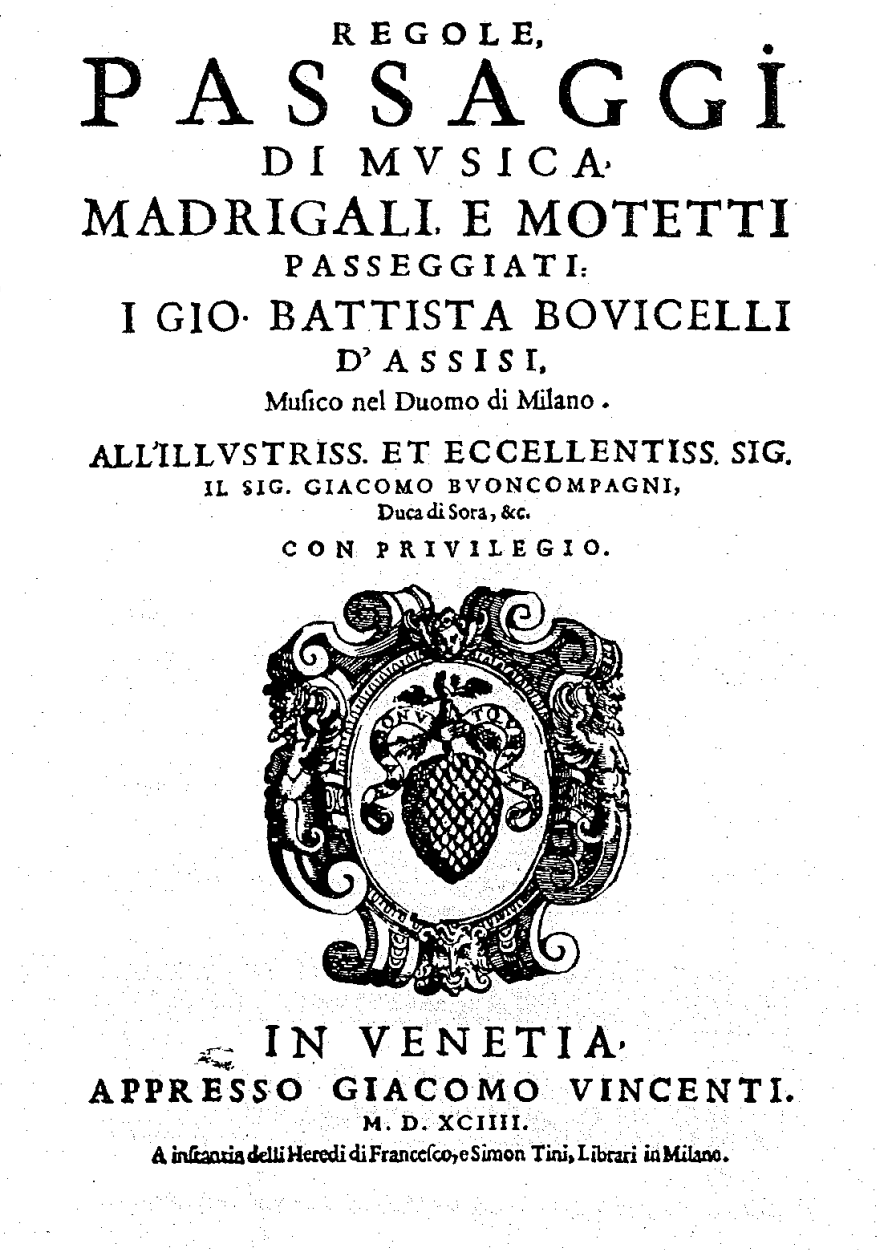
Giovanni Battista Bovicelli’s Regole, passaggi di musica, madrigali e motetti passegiati
Venice, 1594.
The first puzzle was: only every other verse was set to music. Where were the missing verses to come from? And why did Bovicelli’s Magnificat begin with anima mea instead of the opening word Magnificat?
This was my first encounter with alternatim practice. For a church musician in 1600 the answer would have been self-evident: psalms and canticles were normally performed by alternating plainchant with polyphony or organ versets.
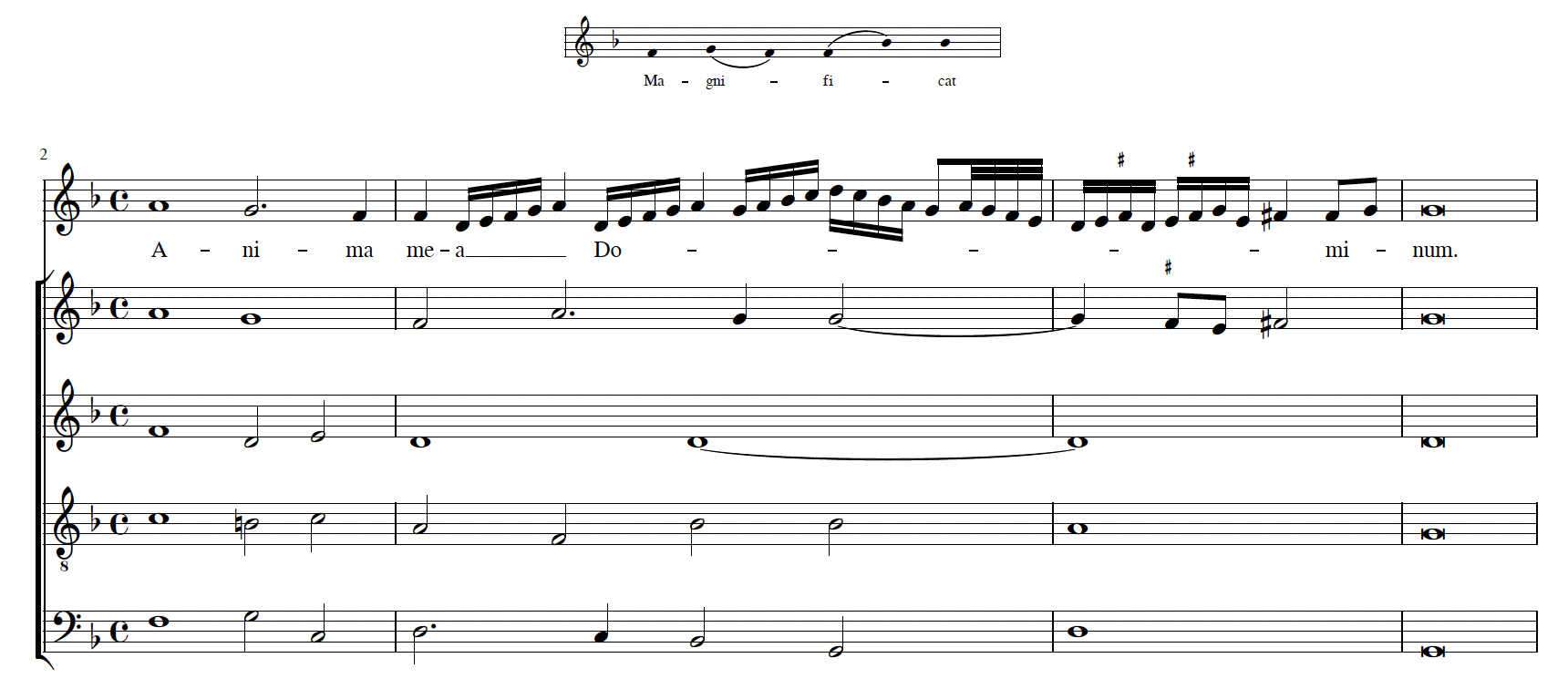
The upper staff supplies an editorial plainchant intonation for Tone 2, while the original falsobordone appears below as instrumental accompaniment to Bovicelli’s embellished cantus.
To understand how Bovicelli’s falsobordoni could be performed, it was necessary to return to the foundations: the psalm tones, their intonations and reciting notes, their cadences and differentiae—those alternative endings designed to lead smoothly back into the antiphon. Modern sources such as the Liber Usualis (1961), alongside contemporary scholars like Bradshaw, Brett, and Dodds, and seventeenth-century writers such as Banchieri and Pontio, were very helpful.
At this point I also had to clarify for myself what a falsobordone actually is. In its classical form it is an extremely simple, chordal setting modeled directly on the Gregorian psalm tone. Each verse is divided into two halves, the parallelismus membrorum, and each half into a flexible recitation on a single harmony followed by a brief cadence with modest melodic motion. There is no word painting and little contrapuntal artifice, and because the recitation chord can be repeated as many times as necessary, the same musical formula can accommodate any psalm verse.
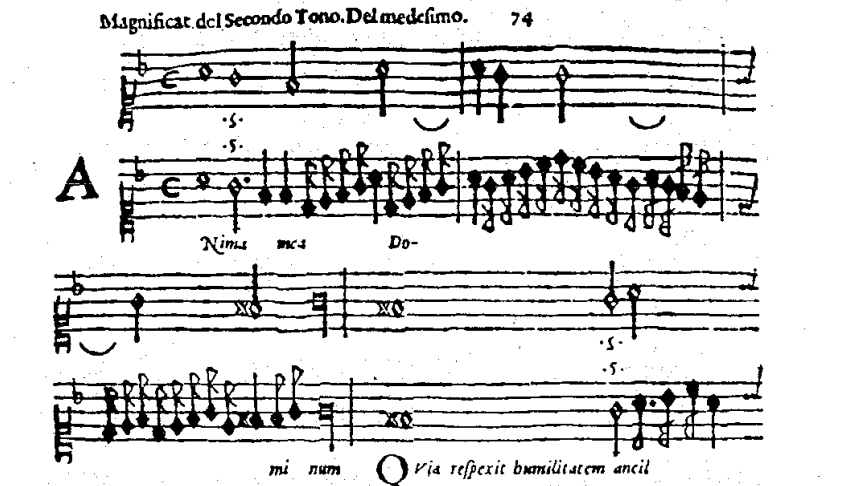
Bovicelli’s embellished cantus for Gabucci’s Magnificat del Secondo Tono. From Regole, Venice, 1594.
The first of the three pieces in Bovicelli’s collection is Gabucci’s Magnificat del Secondo Tono. Why is this Tone II Magnificat notated in G rather than in its natural pitch of D? In seventeenth-century practice the second tone rarely appeared at its original pitch; it was commonly transposed up a fourth to suit the range of the choir.
Gabucci’s composition follows the design inherited from the psalm tone: long recitations on a single harmony followed by concise cadential formulas. Bovicelli transforms those cadences into vehicles for virtuoso diminution while leaving the recitations largely untouched.
Why the opening chord is D major, if the transposed final is G? The piece opens with the chorda mezana, D major, functioning as the dominant of G. The interior cadences are on B♭and C, respectively, moving to the final cadence on G. This harmonic sequence agrees with Banchieri’s descriptions and illustrates the possibility of beginning a homophonic setting on the mezana rather than on the modal final.
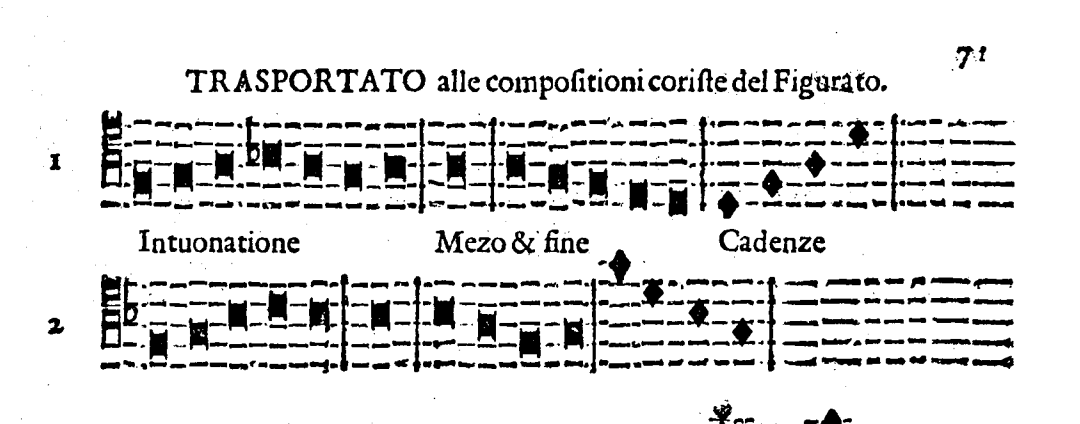
Banchieri’s harmonic outlines for Tones 1 and 2, transposed for canto figurato. From L’Organo suonarino, Venice, 1605.
Bovicelli’s version enters with the second half of the falsobordone on the words “anima mea”; the opening word “Magnificat” is omitted, implying that its intonation was to be sung in plainchant. Only alternate verses are written out, calling for an alternatim: embellished falsobordone for the odd verses, plainchant psalm tone for the even ones.
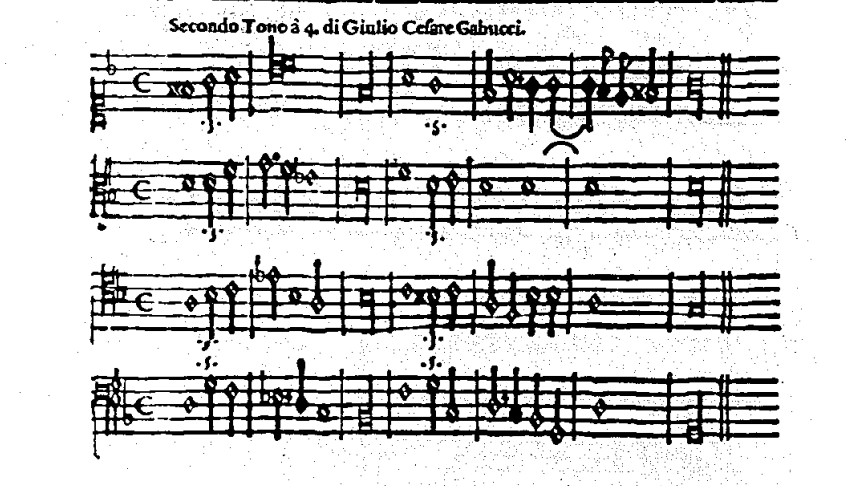
Gabucci’s falsobordone written for Bovicelli’s diminution treatise.
Once the chant verses are inserted, another question arises: which differentia should be used? The Liber Usualis lists many endings, yet these alternatives originally served to reconnect the psalm with its concluding antiphon. When the antiphon is replaced by polyphony or an instrumental substitute, these endings are not necessary, which may explain why most seventeenth-century sources include only the principal differentia of each tone.
Another practical problem concerned the text itself: why at first glance the written falsobordone did not seem to fit the words? The solution lies in the notation: the opening chord of each recitation is meant to be repeated as many times as necessary to accommodate the syllables. This ancient device for setting texts of irregular length is particularly suited to the psalms and canticles.
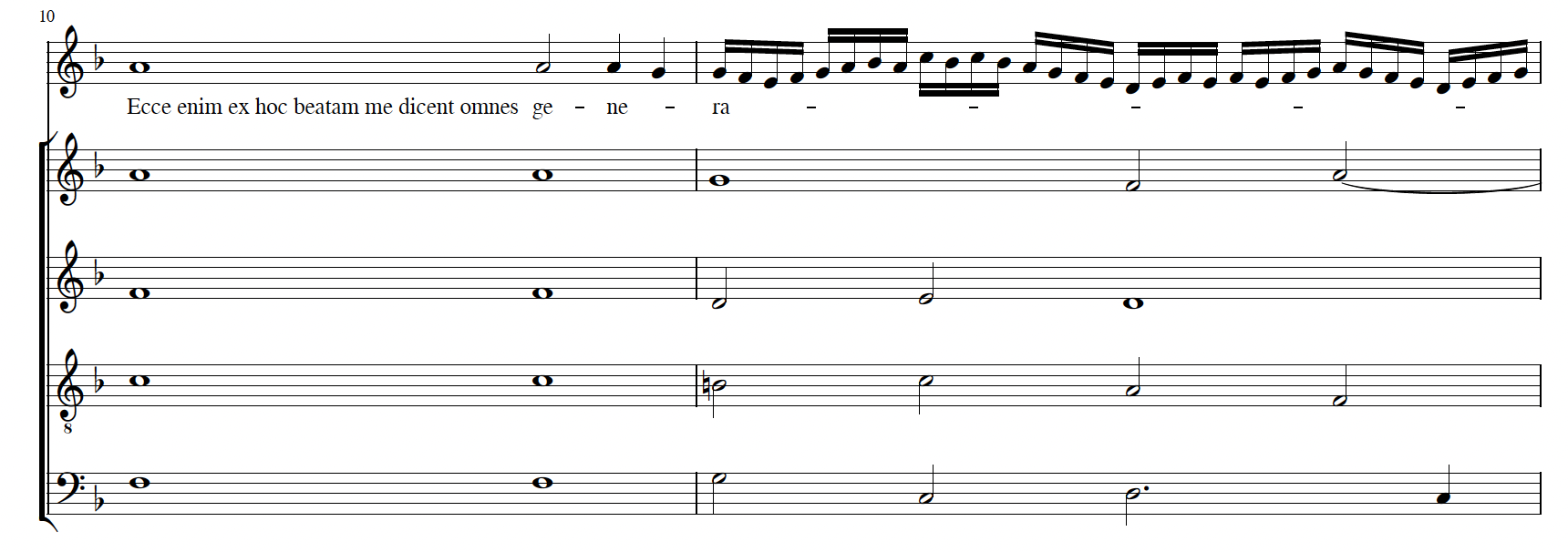
Multiple syllables of the verse are intended to be sung on the initial semibreve, with the opening F chord repeated as needed to accommodate the recitation.
Each verset begins with a semibreve over which several syllables must be sung. How should they be delivered? Like Viadana, Severi advises that the syllables of the recitation should not be equal in duration. The first is gently sustained, the following ones passed more quickly in pairs, and the final vowel of each word slightly lengthened. Above all, the delivery should be graceful—con gratia.

“Et misericordia eius a progenie” underlaid on the semibreve.
Bovicelli’s embellished setting of Giovannelli’s Magnificat del Primo Tono is very similar but offers instructive variants. The opening chord is again the mezana, A major, while the underlying mode remains D. The music begins with Et exsultavit spiritus meus; the first verse, Magnificat anima mea Dominum, is omitted. Thereafter every even verse is set in embellished polyphony, with the odd verses, including the opening one, intended for plainchant in Psalm Tone I.
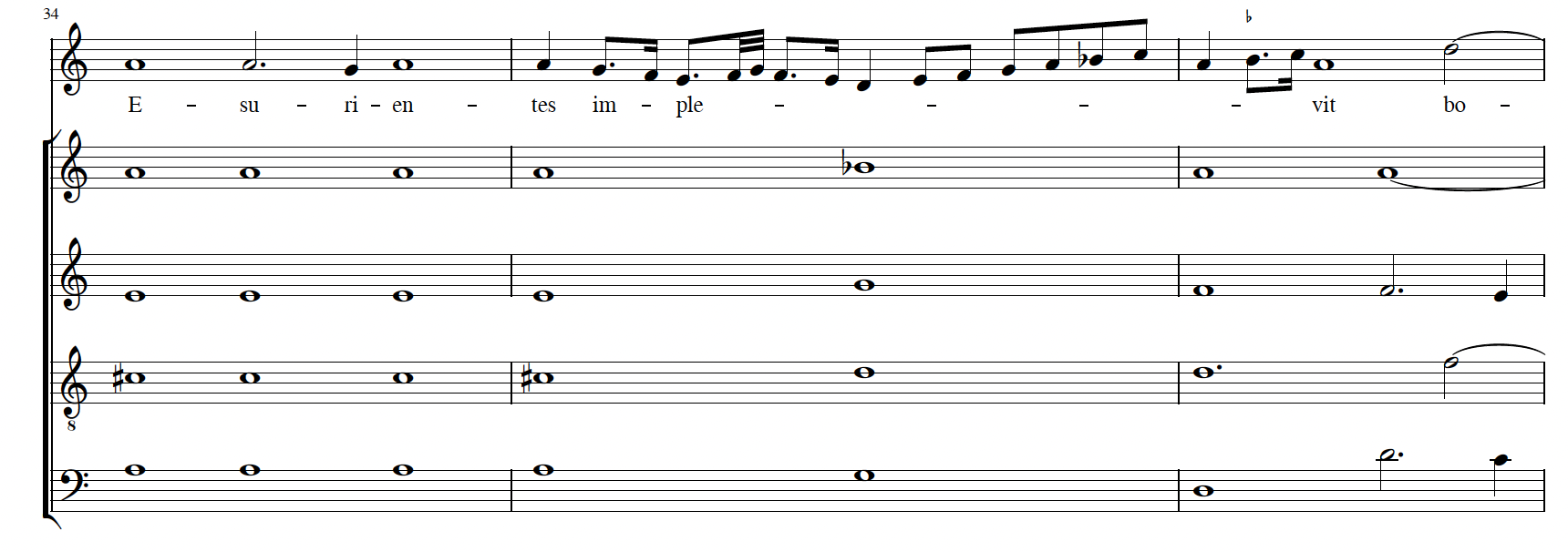
The A major chord is repeated multiple times to accommodate the text.
Such alternation can create tricky cross-relations. Using the principal differentia of Tone I, the chant verset ends on D and the next recitation begins a fifth higher on A, supported by the mezana chord A major. Yet the final chord of the polyphony is D major, so the alternation inevitably juxtaposes F♯ in the polyphony with F♮ in the intonation—a reminder that these works stand between modality and the emerging tonal language.
Giovannelli’s piece employs the natural pitch of the first tone and requires no transposition, whereas Gabucci’s Magnificat reflects the seventeenth-century convention of placing Tone II a fourth higher in G, an adjustment often dictated by organ pitch, temperament, and the singers’ range.
Of the three works, Bovicelli’s Dixit Dominus del Sesto Tono own setting was the simplest to grasp from a modal perspective. It belongs to the sesto tono, whose final is F, and the corresponding psalm-tone differentia likewise concludes on F. This alignment avoids the cross-relations encountered in the Gabucci and Giovannelli pieces between the final chord of the polyphony and the opening pitch of the chant.
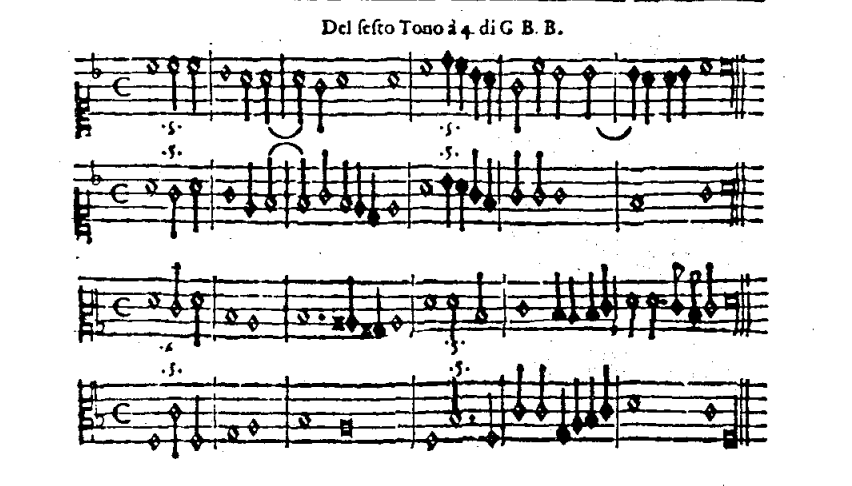
Bovicelli’s falsobordone in Tone 6 for the Psalm “Dixit Dominus”.
A cross-relation nevertheless occurs within the falsobordone itself: the first half closes with a cadence in A major, immediately followed by the second half in F major. The juxtaposition of C♯ and C♮ is inevitable, but contained entirely within the polyphonic verset rather than between polyphony and plainchant.
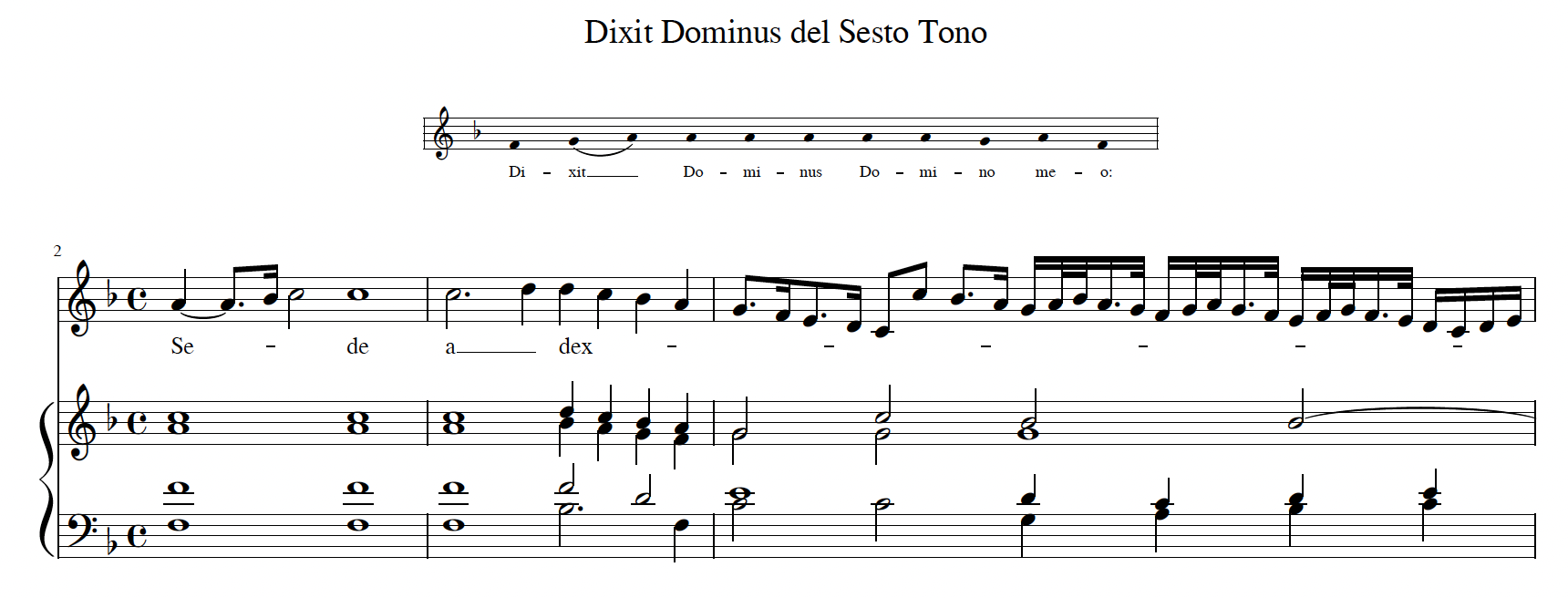
Bovicelli’s embellished falsobordone for the Dixit Dominus del Sesto Tono. From Regole, Venice, 1594.
One of the most fascinating aspects of these works, for me, is the confluence of three distinct ages and traditions: medieval plainchant, Renaissance polyphony, and early Baroque division style. The genre itself mirrors this historical journey—born from the Gregorian psalm tones, shaped by the classical choral music of the fifteenth and sixteenth centuries, and ultimately playing a decisive role in the transition from Renaissance to Baroque, as composers began to experiment with the emerging solo style.
References:
Banchieri, A. (1605). L’organo suonarino. Venice.
Bovicelli, G. B. (1594). Regole, passaggi di musica. Venice.
Bradshaw, M. C. (1978). The falsobordone: A study in Renaissance and Baroque music. American Institute of Musicology.
Brett, U. R. K. (1986). Music and ideas in seventeenth-century Italy: The Cazzati–Arresti polemic.
Dodds, M. R. (1998). The Baroque church tones in theory and practice. University of Rochester.
Liber usualis, with introduction and rubrics in English. (1961). Desclée.
Pontio, P. (1588). Ragionamento di musica. Parma.
Early Music Sources. (2020, January 10). Falsobordone, the Miserere of Allegri, and a most bizarre musicological error [Video]. YouTube. https://youtu.be/j9y5N13un9s